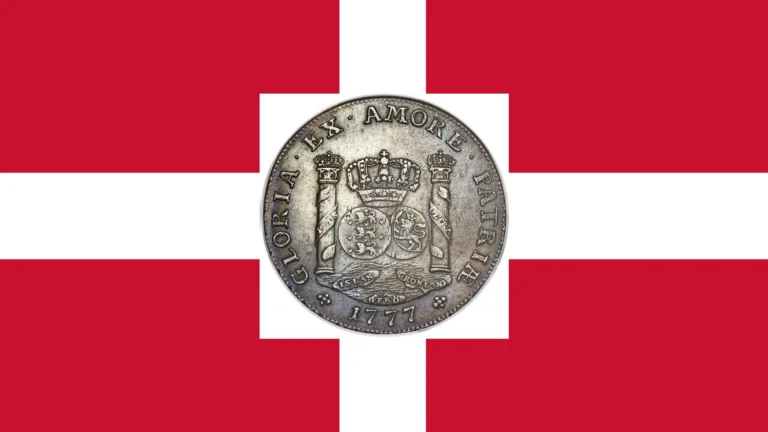
The Pillar Dollar is the quintessential colonial coin and one of the most iconic coins in world numismatics. One of the reasons for this is the importance it gained as the first globally accepted currency. However, Denmark resisted depending on the Pillar Dollar and took another route: it would make its own. This is the story of the Greenland Dollar.
Trade with China
The West began trading with China back in the 16th century. But one of the problems European merchants encountered upon arrival was that the Chinese rulers were only interested in silver. They didn’t want any other goods, just silver.
The Spanish Empire was fortunate because, in its colonial possessions, there was silver in abundance. The mines of America, with Potosí at the forefront, were producing most of the world’s silver.
And with that silver, Spain made coins. Many of them. And they used them to pay for things all over the world. The so-called “Manila Galleon,” which was a regular trade route that carried silver to the Philippines and brought goods to America, was one of the pillars of the imperial economy. The silver that arrived in the Philippines then went to China.
The economic power of the Empire in the 16th century was so great that the Spanish 8 reales coin became the first globally recognized and accepted currency.
The Pillar Dollar
The 8 reales coin had been minted since the 16th century, during the time of the Catholic Monarchs, so it has many different designs. However, the most well-known design—by far—is the Pillar Dollar, named after the colonial coat of arms that appears on the reverse.
It was minted in different mints in Latin America from 1732 to 1773 and soon became the preferred method of payment throughout China. Given two coins of equal silver content, a Chinese merchant would always accept a Pillar Dollar over any other coin, simply due to the prestige associated with this piece.
The other powers had no choice but to adopt the 8 reales and countermark it, thus placing a barrier to the independence of their Asian trade, which to some extent came to depend on the Spanish Empire. By the way, this is the origin of trade dollars, which we will discuss in another entry very soon.
Seeing the situation, instead of countermarking the 8 reales coins to identify their origin without losing prestige, Denmark chose another path: they were going to make their own Pillar Dollar.
The Greenland Dollar
The name “Greenland Dollar” is somewhat misleading. In reality, this coin was not minted to circulate there, but in the Far East. However, it is one of the few Danish coins that include the names of what were Denmark’s island territories at that time: Greenland, the Faroe Islands, and Iceland.
Officially, the denomination of the Greenland Dollar is 1 piastre. It appears with two minting dates, 1771 and 1777, under the reign of Christian VII. However, the 1771 coin was actually minted in 1774, the year when the Danish Asiatic Company ceded the rights for commercial exploitation of the Far East to the Kingdom of Denmark.
According to the Salvesen catalog, which is the one cited by Heritage whenever one of these is auctioned, a total of 44,900 pieces were minted, but only between 20 and 22 specimens remain in total, of which 12 are in museums. The hammer price of the last three Greenland Dollars auctioned (all three in 2018) was $96,000, $90,000, and $76,000. Quite a sum.
This coin has two varieties. In the KM#639.1 variety, the name of Iceland is written as “ISLAND.” In the 1777 version (KM#639.2), however, it appears as “ISLAN.”
Differences between the Greenland Dollar and the Pillar Dollar
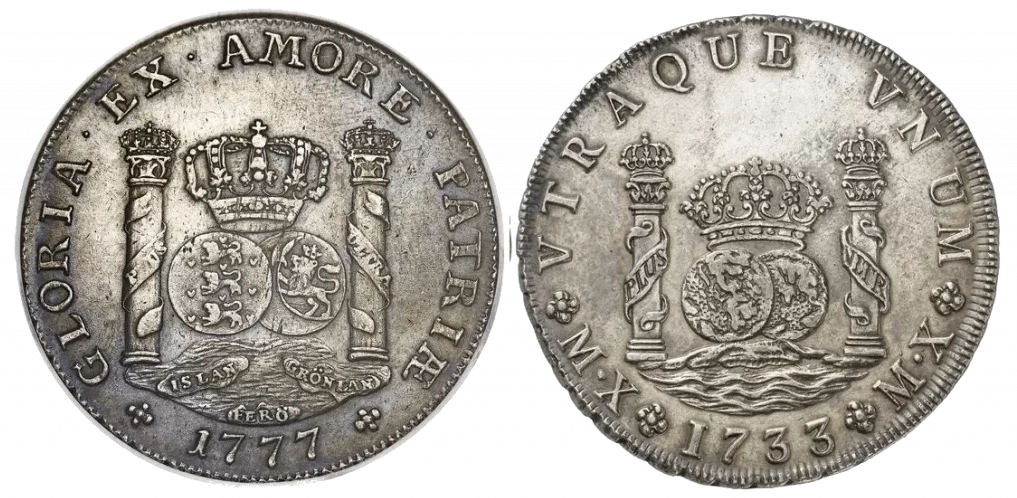
If you place the Greenland Dollar and the Pillar Dollar side by side, you have to look closely to see the differences. And you see them because you understand the Latin alphabet. Imagine if you were a Chinese person in the 18th century and all your life you had only seen Chinese characters. They would easily fool you, no doubt. It even has the “PLVS ULTRA”, which was the Spanish state motto at the time.
To the left, the Greenland Dollar. To the right, an 8 reales coin minted in México in 1733.
Basically, on the reverse of both coins, there are only four differences:
The names of Iceland, Greenland, and the Faroe Islands are introduced in the sea.
On the globes, the world spheres are replaced by the coat of arms of Denmark.
There is a small size difference. The Greenland Dollar weighs 26.98 grams and measures 39.6 mm, while the Pillar Dollar weighs 27.07 grams and measures 40 mm.
The famous “UTRAQUE UNUM” of the Pillar Dollar is replaced by the Danish motto in Latin “GLORIA EX AMORE PATRIÆ”, which means “the love of the homeland is my reward.”
On the obverse, the coat of arms of Denmark is different, but it is also designed to resemble as closely as possible that of the Spanish monarchs, adding another layer of “deception.”
The Pillar Dollar is the colonial coin par excellence and one of the most iconic coins in world numismatics. And there is a reason for that: if you add to the spectacular reverse design the importance it gained as the first global currency, the result is that there are very few numismatics enthusiasts who do not have or want one.
And I’ll tell you, after writing this article, now I want two.
Yesterday, May 13, 2024, marked the 20th anniversary of the release of the first commemorative 2-euro coin in history. To celebrate this significant milestone, I thought it would be a good idea to chronologically review what I consider to be the most important commemorative 2-euro coins.
By “most important” I don’t mean the most valuable or rare, but those that have had the greatest impact on shaping what we now understand as the collection of commemorative 2-euro coins.
Let’s get started:
Greece 2004 – Olympic Games
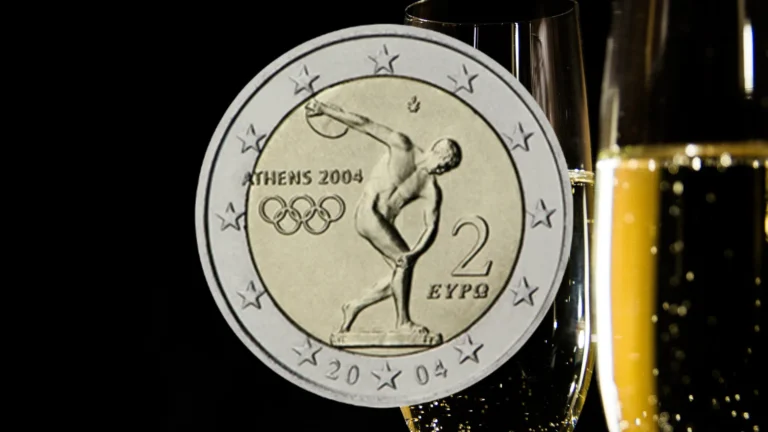
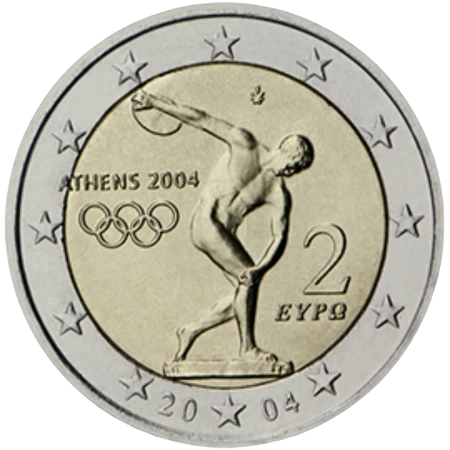
The first commemorative 2-euro coin in history was the 2-euro coin from Greece in 2004, dedicated to the Olympic Games held in Athens that year.
The first one ever.
Issued on May 13, 2004, it was the first in a collection that, over these 20 years, has become one of the most significant in numismatic history, both in scope and in the number of collectors.
As I write these lines, more than 500 coins have been issued, which I personally estimate are collected, in one way or another, by over 300,000 people across the European continent.
Germany 2006 – Schleswig-Holstein
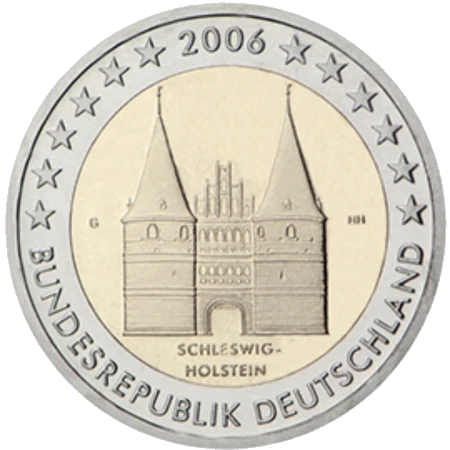
The 2-euro coin from Germany in 2006, dedicated to the federal state of Schleswig-Holstein, was the first coin in the first thematic series of euros issued by a country: the Bundesländer series, dedicated to the German federal states.
The depicted monument is the Holstentor, in the city of Lübeck.
The series of 2-euro coins involve a specific country issuing one (usually) coin per year that has a thematic connection with its coins from other years.
Since Germany started the Bundesländer series in 2006, six other countries have followed suit. Today, we have series as short as four coins, like the Regions of Latvia series, or as long as 50 coins, like Spain’s UNESCO World Heritage series.
The 13 coins of the 2007 Treaty of Rome Series
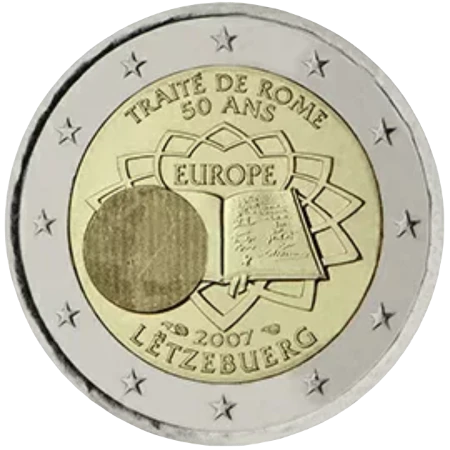
In 2007, the first example of international coordination in the issuance of 2-euro coins took place: the common series dedicated to the 50th Anniversary of the Treaty of Rome.
For this series, the European Commission coordinated the 13 states that comprised the Eurozone at the time to release a coin featuring the same design for all countries, with only the language of the inscriptions and the name of the issuer differing. And to release it on the same day, March 25, 2007.
Since then, there have been five common coin issues, the latest in 2022 for the 35th anniversary of the Erasmus Program. Additionally, there have been a few common mini-series, where two or three countries agreed to issue the same design, such as in 2018 when the three Baltic republics celebrated their centennial.
Luxembourg’s version.
Additionally, the 2007 2-euro coin from Luxembourg dedicated to the Treaty of Rome was the first to incorporate what is technically known as a latent image and popularly as a hologram. This technology, invented by the Spanish mint (FNMT), allows different images to be seen depending on the angle at which the coin is viewed. In the case of the Luxembourg coin, one angle shows the original design and another shows the portrait of Grand Duke Henri.
This technology was used because Luxembourg law requires that the portrait of the reigning Grand Duke appear on its coins. However, Helmut Andexlinger’s original design did not leave space for the portrait, so the latent image was incorporated as a solution to this dilemma.
Monaco 2007 – Grace Kelly
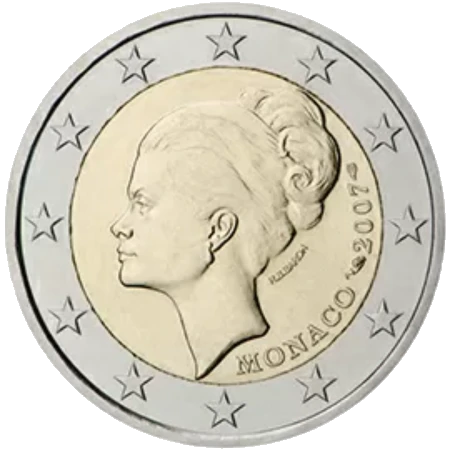
Although there had been some previous instances of coins that were not circulated but were issued exclusively in collector’s editions, the 2-euro coins from Monaco in 2007 dedicated to Grace Kelly marked the beginning of a type of collecting that had been almost absent in 2-euro coins until then: speculative collecting.
The crown jewel in the 2 euro coin collection.
With a measly 20,001 coins minted, the Grace Kelly coin was, at the time of its issuance, the 2-euro commemorative coin with the lowest mintage. As we mentioned earlier, there are around 300,000 collectors of 2-euro coins, so the mintage fell far short of demand, causing the coin to rise in price in the secondary market to over 3,000 euros.
The result was that a new type of collector with a more investor-oriented profile entered the world of 2-euro commemoratives.
Thus, the three types into which commemoratives can broadly be divided would be configured as follows: a) those intended for circulation, b) those intended for collectors, and c) those intended for investors.
Luxembourg 2012 – Wedding of Guillaume and Stéphanie
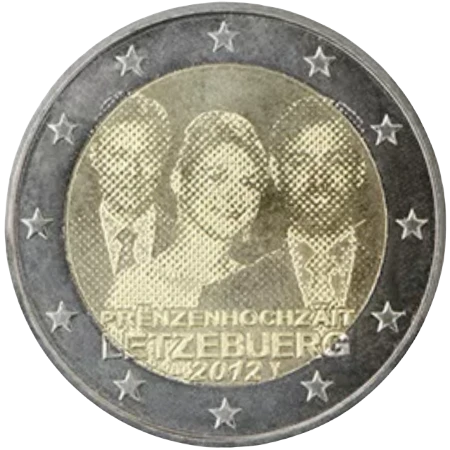
In 2012, the European Commission granted permission to Eurozone countries to issue two commemorative coins per year, instead of just one as had been done previously. The first country to take advantage of the new regulation was Luxembourg, with its 2-euro coin dedicated to the Wedding of the Hereditary Grand Duke Guillaume and Stéphanie de Lannois.
This coin is also the first to use a special minting technology which basically involves reproducing a real photograph on the metal of the coin.
Ironically, the picture looks terrible on a picture. It looks better when you have it in your hand.
After its issuance, the number of commemorative coins issued per year exploded thanks to the change in rules by the European Commission and the entry of new countries to the Eurozone, rising from 16 in 2011 to 36 in 2023.
Luxembourg, for its part, would issue several more coins with photographs, even going so far as to issue in some years (before the European Commission intervened and stopped them) the same coin in two different versions, one with a traditional engraving and another with a photograph.
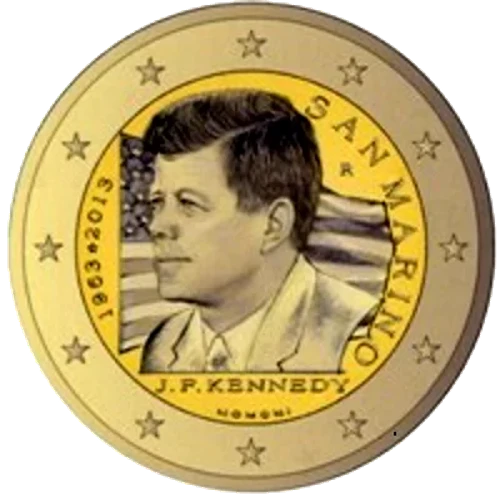
San Marino 2013 – John Fitzgerald Kennedy
Some countries have a rather extensive history of issuing their coins with the aim of maximizing profits from collectors, using themes that have very little to do with the history or culture of the issuing state.
The most blatant case was that of San Marino and its attempt to issue a coin in 2013 dedicated to John Fitzgerald Kennedy on the occasion of the 50th anniversary of his assassination. It was a shameless appeal to the most powerful numismatic market in the world, the United States, with theme that had absolutely nothing to do with San Marino or Europe.
It was designed by Claudia Momoni.
This coin was never issued, mainly because the European Commission objected to the theme during the mandatory consultation period that any design must undergo. It was replaced by one dedicated to Pinturicchio.
Thanks to this attempted issuance, and to prevent such thematic abuses from happening again, the Commission finally officially defined which themes could be depicted on a coin: those related to a country of the European Union.
However, this did not prevent San Marino from betraying the spirit of the rule in 2016 by dedicating a piece to William Shakespeare, in a clear attempt to court the British numismatic market.
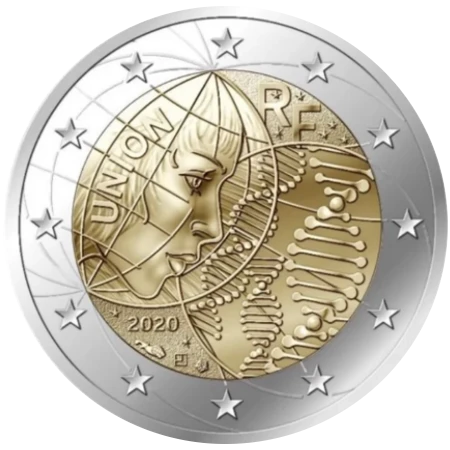
France 2020 – Medical Research
Until 2020, the themes of commemorative 2-euro coins could be classified into two main types:
Things that had already happened, such as anniversaries of births or deaths of important people, significant events in history, or the founding of institutions.
Things that were going to happen, such as the Olympics or European Presidencies.
However, in 2020, amidst the peak of the pandemic, France issued a coin dedicated to Medical Research, clearly referencing the urgent process of developing a vaccine for COVID. At that moment, a new type of theme emerged: things that were happening.
One of the most beautiful coins in the collection, in my opinion.
This new type of coin aims to grab the population’s attention – and maintain morale – about a problem affecting Europe and/or the world. Since the French one was issued, we’ve seen quite a few more pieces dedicated to the fight against COVID, but also in support of Ukraine against the Russian invasion.
I think these coins are the most significant in the collection from a historical perspective. When numismatists 400 years from now come across the fact that four or five states issued multiple coins related to a specific event while it was happening, they’ll be able to grasp the importance we attached to it, we who lived through that event.
To top it off, the French coin was issued entirely on the fly, as the French numismatic program stated that in 2020, the first coin of an annual series dedicated to the Paris 2024 Olympics would be released. But when the Tokyo 2020 Games were postponed to 2021, the French series had to be delayed as well.
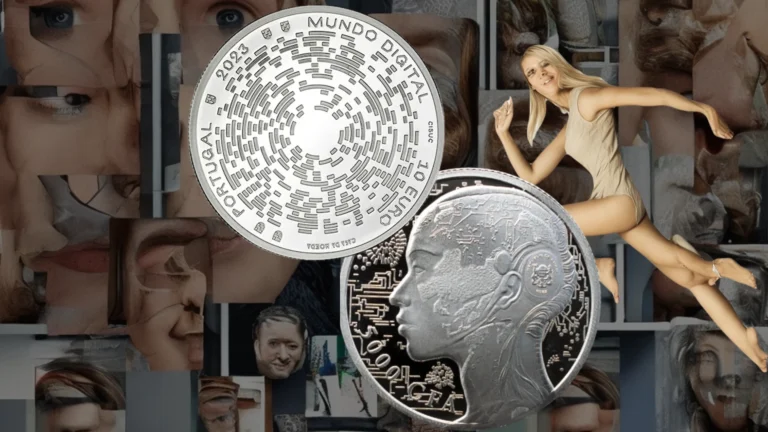
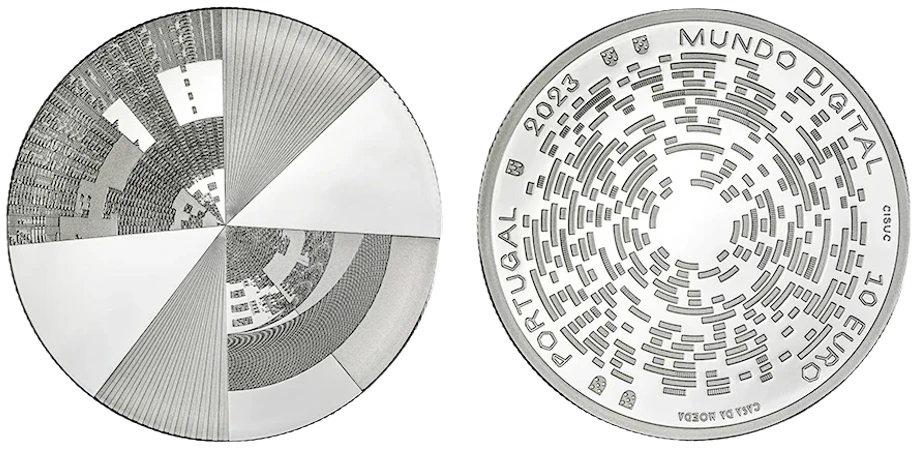
On December 11, 2023, Portugal issued a 10 euro coin titled ‘O Mundo Digital’ (‘The Digital World’). This was one among the many coins they issue throughout the year. The difference lies in the promotional materials where they proudly announced that INCM, the Portuguese mint, had collaborated with the Centre for Informatics and Systems of the University of Coimbra (CISUC) to create the first coin in history designed by an artificial intelligence.
However, this is only half true: it is indeed the first one issued by a public mint, but not truly the first of its kind.
Portugal – 10 Euros 2023 “The DIgital World”. It’s a .925 silver coin measuring 40 millimeters in diameter and weighing 27 grams, and a mintage of 4,000 pieces (Photo: INCM)
The design process of the coin is detailed on the CISUC website. Although relatively short, I found it quite interesting: basically, they trained an AI from scratch.
At the beginning of the project, they experimented with commercial AIs like DALL-E, Midjourney, or Stable Diffusion, but they discarded them because, and I quote: “These attempts gave us expectable and disappointing results. The coins were clichés and pastiche imagery, including the popular representation of AI as the profile of a female face with a digital circuit on the brain (usually facing left).”
Contrary to what the INCM said, CISUC never claimed that this coin was the first of its kind in the world.
Which coin was really the first one?
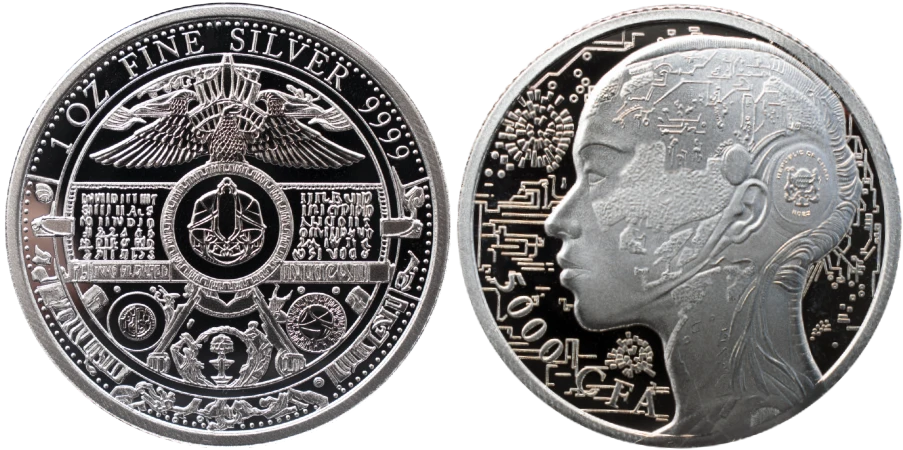
The first coin truly designed by an artificial intelligence, to my knowledge, is a 5000 CFA franc coin issued by Chad, released on October 19, 2023, by the Pressburg Mint, a private company based in Slovakia.
Chad – 5000 CFA Francs 2023 “AI”. It’s a one-ounce .9999 silver coin measuring 38 millimeters in diameter and weighing 31.1 grams. Its mintage was 30,000. (Foto: Pressburg Mint).
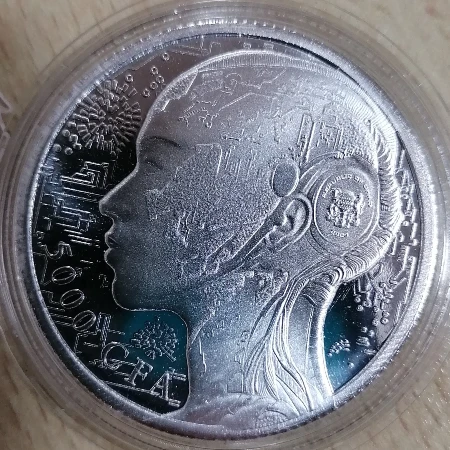
What’s the design like? Well, it’s the popular representation of AI as the profile of a female face with a digital circuit on the brain, looking to the left.
Exactly what the CISUC said they didn’t want for their coin.
The obverse of the 5000 CFA francs coin from Chad (Photo courtesy of a reader of ColeMone).
This makes me think that:
The design from the Pressburg Mint is rather lazy. They might not have taken the very first thing DALL-E or Midjourney showed them, but I wouldn’t be surprised if they settled for the second.
Although the CISUC project started on August 1, 2022, well before the Chad coin was released, the criticism they make is so specific that I believe they must have seen it at some point.
The INCM pulled their claim that the Portuguese coin was the first out of thin air, without verifying anything at all.
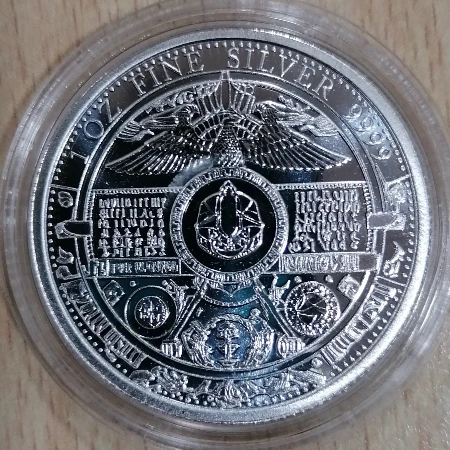
The reverse of the 5000 CFA francs coin from Chad (Photo courtesy of a reader of ColeMone).
When the Portuguese coin came out, I reported it on ColeMone’s Spanish-language Miniblog on Telegram, and I repeated like a little parrot the information in the promotional materials of INCM. My thanks to the reader who alerted me to the existence of the coin from Chad, which is the same person who sent me the images of their own one.
Let this article serve as a correction to that post on the Miniblog.
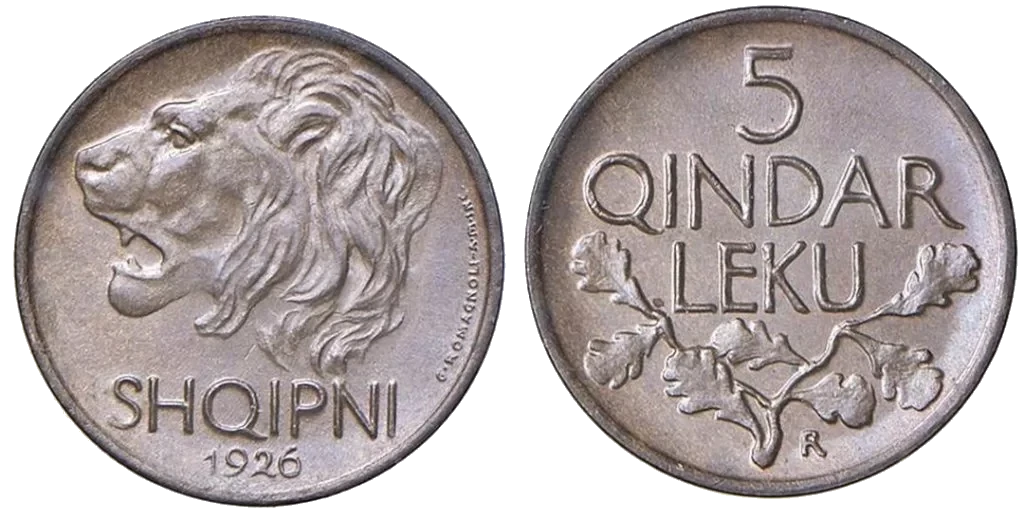
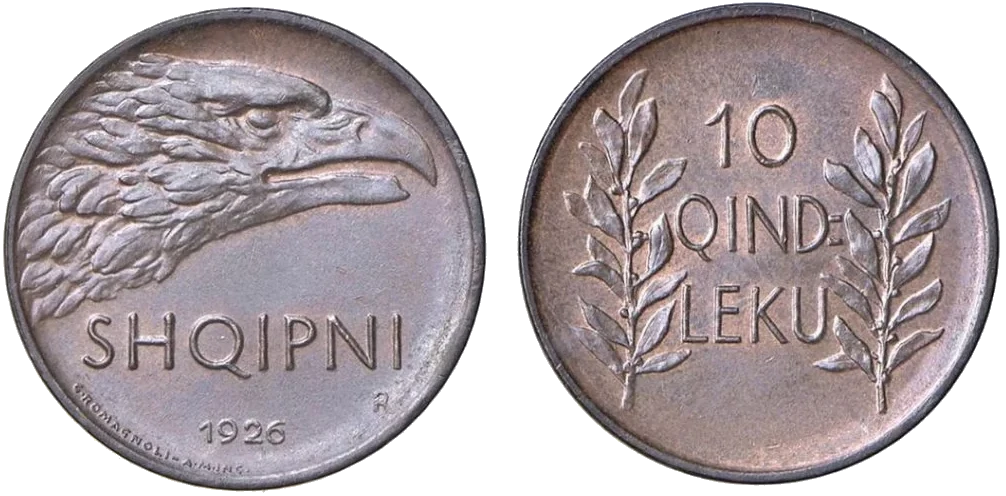
You might already know that from time to time I like to write an article about a coin or banknote series that I think deserves much more recognition than it actually gets in the collecting world. With that spirit, today we take a look at the beautiful 1926 coin series from Albania.
I’ll show them to you below. But, to truly understand where such a beautiful series comes from, we have to dive into Albania’s interwar history.
So let’s get to it.
The First World War in Albania was brutal
The beginning of modern Albania’s existence as a country is relatively recent. After over 500 years of Ottoman domination, the 1913 Treaty of London, which ended the First Balkan War, recognized Albania’s independence.
In that treaty, the Great Powers imposed a monarchy on Albania, which would now be a principality. The new monarch would be some German prince named Wilhelm of Wied, who took the name Vilhelm I. And that would be the only Albanian thing about him. He knew nothing about the country, its language, its customs or its political situation.
Furthermore, the Great Powers established an International Control Commission with representatives from each of them, who would exercise close surveillance over the new country.
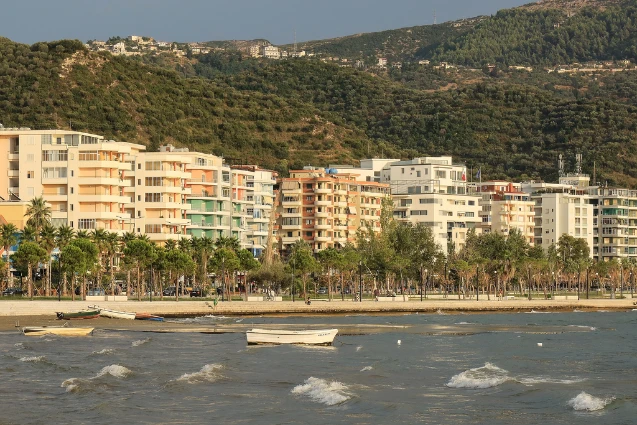
But since 1912, not one, but two different governments had been competing for power in the country. One was the Provisional Government of Albania, with its capital in Vlore and Ismail Qemali in charge, who is now considered the father of the Albanian state. The other was the Central Republic of Albania, with its capital in Durres, headed by Essad Pasha and sporting a traditional Muslim character.
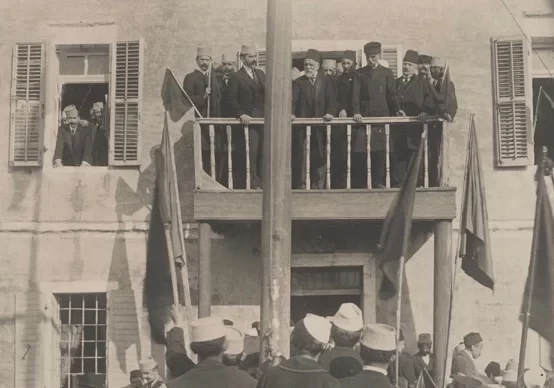
Ismael Qemali, in the center of the balcony, giving a speech in 1914 (Photo: Commons/Petro Dhimitri).
Well, Prince Wilhelm arrived in Albania on March 7, 1914. And the first thing Pasha did was to mount a rebellion of Muslim peasants against him.
It would be quashed by Dutch, Italian, and Austrian soldiers commanded by the International Control Commission. But this was just the first example of a series of almost simultaneous rebellions in the north and south of the country along ethnic and religious lines, while neighboring countries interfered in Albanian internal affairs at the slightest opportunity, and the Commission itself constantly undermined the Prince.
And on July 28th, the First World War broke out.
Faster than a birth, busier than the toilets at a music festival
Guillermo tried to keep the country in a state of neutrality, but he failed. On September 3, he grabbed his things and went into exile. He was monarch for less than 9 months.
From then on, the situation became anarchic, and Albania became a battlefield. Almost immediately, neighboring countries sent their troops into Albanian territory. First, Serbia occupied the center and north, Greece the south, and Italy the city of Vlore (which had been promised to them if they entered the war on the side of the United Kingdom, France, and Russia).
In 1915, Austro-Hungarian and Bulgarian troops ousted the three occupiers and established what they called a “friendly occupation.” They left the existing local administration in power and began to promote the use of the Albanian language to try and counter the growing Italian influence in the area.
In 1916, France and Italy occupied the south of Albania. And the situation remained that way until the end of the war, when the Salonica Front finally collapsed and the Austrians withdrew from the country.
Long story short, six different countries occupied Albania in four years.
Risk of Disappearance
The major concern for Albania in the last moments of the war was the possibility of the country being partitioned and divided among its neighbors. Greek, Italian, and Yugoslavian interferences in Albania’s political life were still enormous.
And that fear was further exacerbated when at the Paris Peace Conference, which was going to definitively end the Great War, Albanian delegates were rejected at the door. Suddenly they were desperate, so they offered to put an Italian prince on the throne of Albania and firmly enter the Italian sphere of influence.
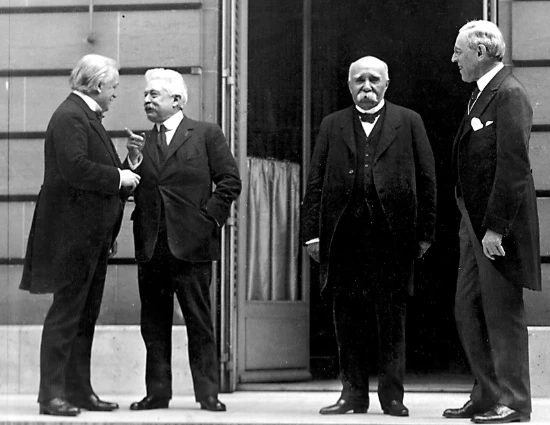
These four run the show at the Paris Conference. From left to right: David Lloyd George, Prime Minister of the United Kingdom; Vittorio Emanuele Orlando, Prime Minister of Italy; Georges Clemenceau, Prime Minister of France; and Woodrow Wilson, President of the United States (Photo: Commons/Edward N. Jackson).
But it wasn’t enough. Officially, the treaty was going to recognize the spheres of influence of the three neighbors.
And today Albania wouldn’t exist if it weren’t for the personal insistence of Woodrow Wilson, President of the United States, who blocked the Peace Treaty until Albanian independence was recognized.
Although officially Albania would still be a Principality governed by a Regency Council, in practice there was no unified command. Between July and December 1921, up to 5 prime ministers passed through the government.
And all of this, after having fought a war to oust Italian troops from Vlore, and with part of the north of the country declaring independence for a few months, with the name of the Republic of Mirdita.
Albanian soldiers during the Vlora War (Foto: Commons/Unknown).
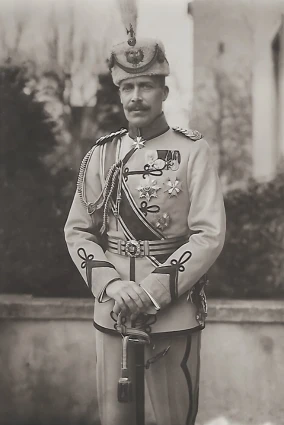
In the last of those five governments, there was a rising star, a guy who at just 24 years old had already been appointed Minister of the Interior: Ahmet Muhtar Zogolli. History would eventually know him as Zog of Albania, but I’m getting ahead of myself.
Civil War
Zog soon revealed himself as a despot. In fact, the fall of the government in which he served as minister was his fault. When he ordered the use of disproportionate violence against peasants in the central part of the country to disarm them, some ministers, led by Fan Noli, resigned from the government.
His redemption in the eyes of Albanian elites came when he defended Tirana from a rebellion of those same peasants he tried to disarm, which arose directly from that disproportionate violence. In 1922, he was offered the position of Prime Minister.
But Noli and Zog had already become irreconcilable enemies, and soon they were engaged in a civil war. Noli was supported by Italy, and Zog by Yugoslavia, to whom he promised territories and influence if they gave him soldiers.
And in 1925, he proclaimed Albania as a republic, and although officially he was the President, in reality, he was a bloodthirsty dictator who did not hesitate to repress any hint of opposition that emerged.
But his promises to Yugoslavia amounted to nothing. He soon turned around and began to approach Benito Mussolini. And Mussolini, knowing that Zog had no choice but to do what he wanted, and if not, there would be a Yugoslav invasion of Albania, began to dig his claws into more and more areas of Albanian political, social, and economic life.
Including the Central Bank of Albania, which was forcibly relocated to Rome in 1926, remaining under total Italian control.
The 1926 Albanian coin series
It was precisely under the Italian Central Bank’s control when in 1926, the first series of coins of modern Albania was issued.
The series is composed of 9 coins, and all of them were in circulation.
The first is the 5 Qindar Lek, or centimes of lek, made of bronze. With a mintage of 516,000 coins, they are worth between 100 and 150 bucks in high conservation today.
The 10 Qindar Lek piece, also made of bronze, had a mintage of 511,000 coins. Currently, I would pay between 120 and 170 bucks for a uncirculated piece.
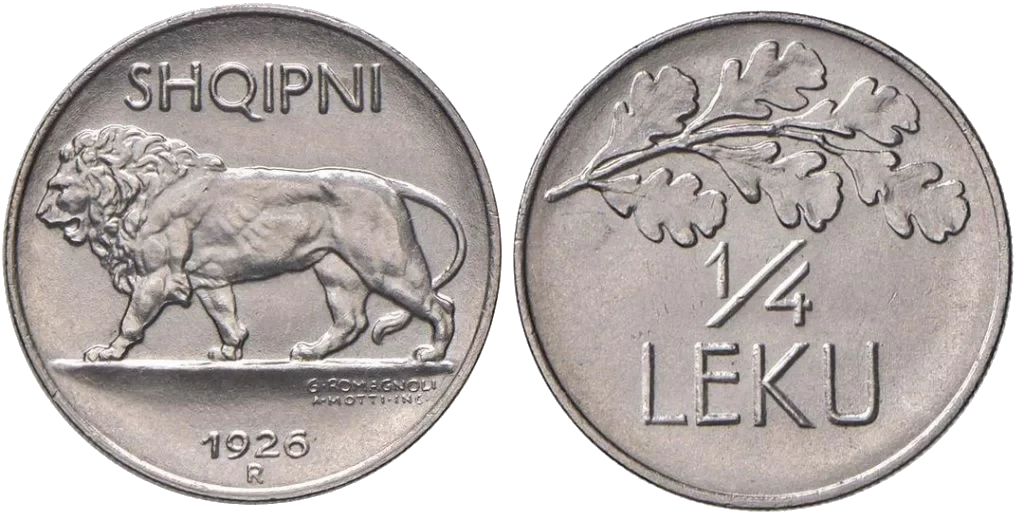
Next is the 1/4 lek. Made of nickel, they had a mintage of 506,000 coins in 1926 and 756,000 in 1927. They are very easy to find in average conservation for about 5 bucks, and in high conservation states, for between 40 and 60 bucks.
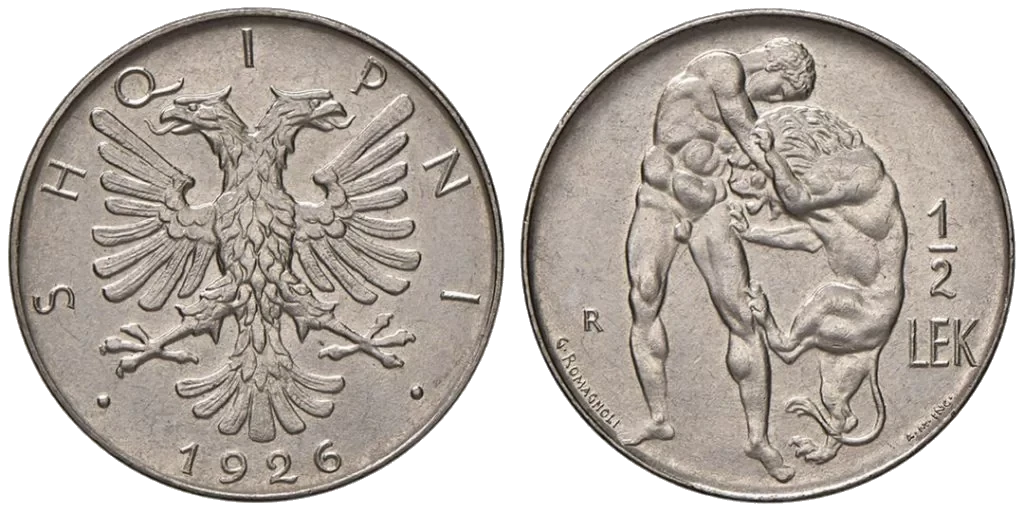
We move up a notch on the scale and go to the 1/2 lek, made out of of nickel. With a mintage of 1,002,000 pieces, one in average condition is worth between 2 and 4 bucks, the price of a coffee. In high conservations, between 10 and 15 bucks.
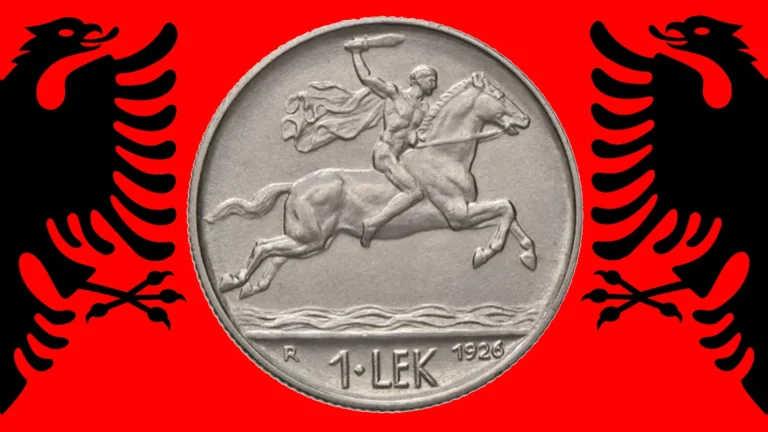
We arrive at the units: the 1 lek coin, made of nickel. This is the easiest to find in this series, as over three million were issued between 1926 and 1932 (although those from 1932 are dated 1931). Like the previous one, a coin in decent condition can be obtained for a couple of bucks. A uncirculated one, for about 10 bucks.
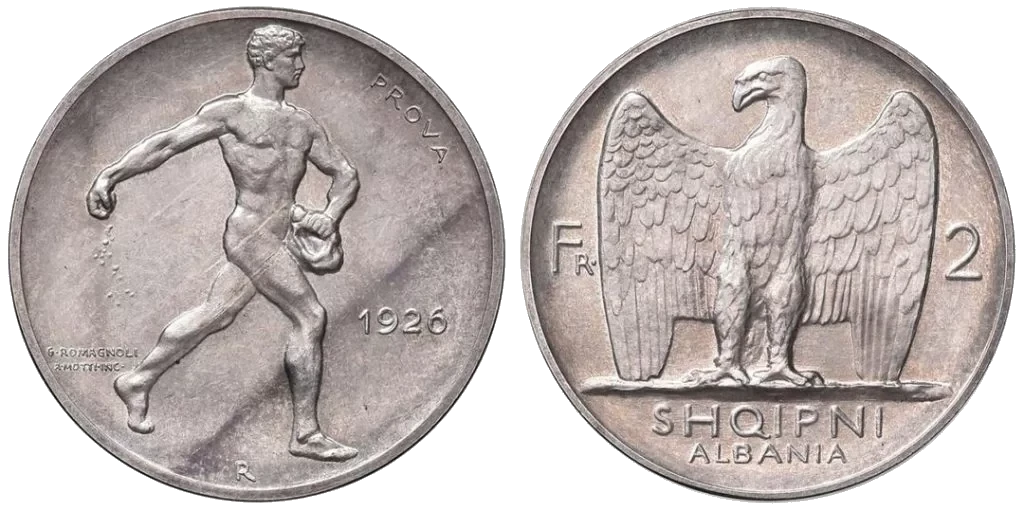
In the next level, the coin series takes a rare leap to the 2 Franga Ari, which is worth 10 leks. They are made of 10 grams of .835 silver and about 160,000 were issued between 1926 and 1928. In high conditions, they can range from 500 to 700 bucks.
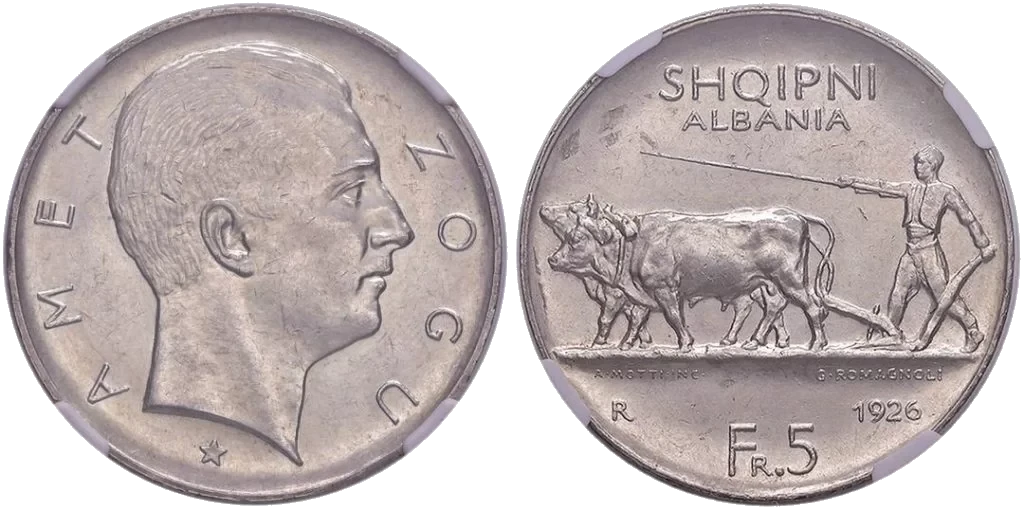
The second and last silver coin in the series is the 5 Franga Ari, equivalent to 25 leks, with its 25 grams of .900 silver and a not insignificant 37 millimeters in diameter. 100,000 were issued between 1926 and 1927, and today, in high conservations, it is worth between 1,000 and 1,200 bucks. In worse conditions, it is rare to see them for under 600 bucks.
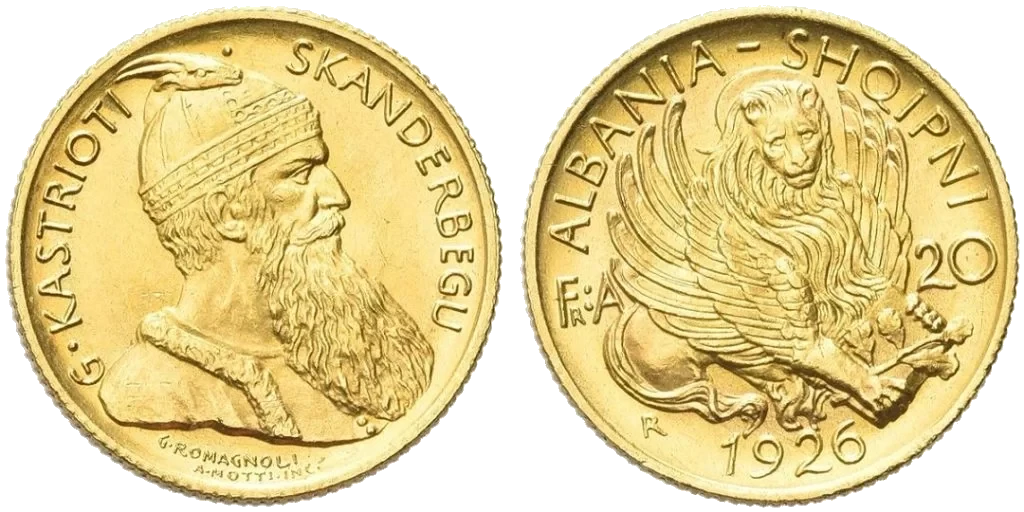
We now enter the crown jewels of the 1926 Albanian series: the gold coins. The first is the 20 Franga Ari piece, equivalent to 100 leks. It is made of 6.56 grams of .900 gold, and there are several variations. The rare variant, which has some fasces and of which there are 100 pieces, is worth about 9,000 bucks. The standard coin, which is the one in the photo, had a mintage of about 10,000 coins and is worth between 2,400 and 2,600 bucks in high conditions.
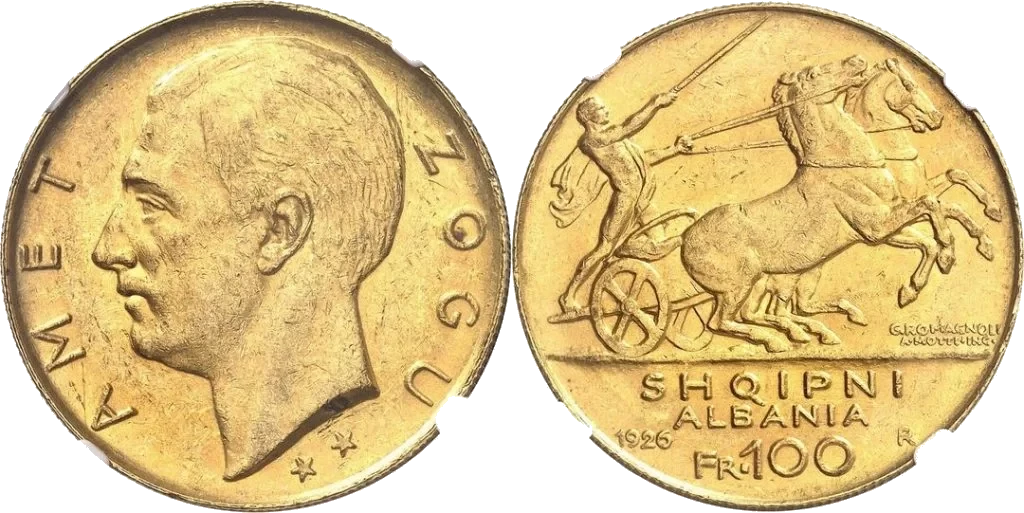
And the last coin in the series is the 100 Franga Ari, equivalent to 500 leks. It is a huge coin: 32.25 grams of .900 gold in 35 millimeters. It has three variations depending on the number of stars below Zog’s head (none, one, or two). With a mintage of 6,614 pieces, the value in high conservations is between 3,000 and 3,500 bucks.
All of them were minted in Rome, except for the 1930 and 1931 1 lek coins, which were minted in Vienna and London respectively, for reasons that we will see below. And they were all designed by Giuseppe Romagnoli, the same artist who would sign one of the most beautiful coin series of the 20th century, the 1936 Serie Imperio of Mussolini’s Italy.
Given the fame that the Serie Imperio has among coin collectors around the world, perhaps that’s why the design of the Albanian pieces reminded you of something you had seen before.
How did Zog end up?
Well, Zog proclaimed himself King of Albania in 1928. He managed to stabilize the country with his dictatorial ways, but Italian influence continued to grow.
After the Great Depression of 1929, the Albanian economy imploded, and it had to borrow money from Italy that it could not repay. In response, Italy demanded that Albania enter into a customs union with them, that the police be under Italian control, a monopoly on the country’s most important exports, and that Italian be taught in schools.
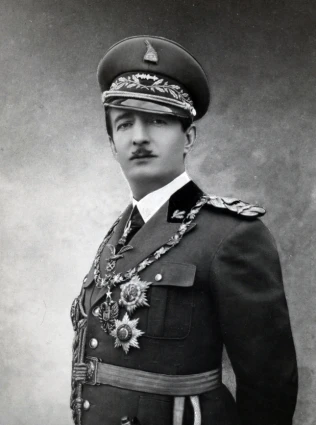
No, it’s not Charlie Chaplin. It’s Zog of Albania already as King (Photo: Commons/Unknown).
Zog said no way and kicked the Italians out of education and the army, and cut the country’s budget by 30% to avoid having to ask Mussolini for more money. He also tried to get closer to France, Austria, and Great Britain, but they basically gave him the runaround (which is why the 1930 and 1931 1 lek coins were minted in Vienna and London).
With no foreign support, Zog had to return to the Italian orbit. But Mussolini no longer trusted him, and in 1939 he invaded Albania and annexed it.
One of the big questions that many people ask about coin grading by companies such as PCGS is whether their famous holders, also known as slabs, are airtight or, conversely, the let air in.
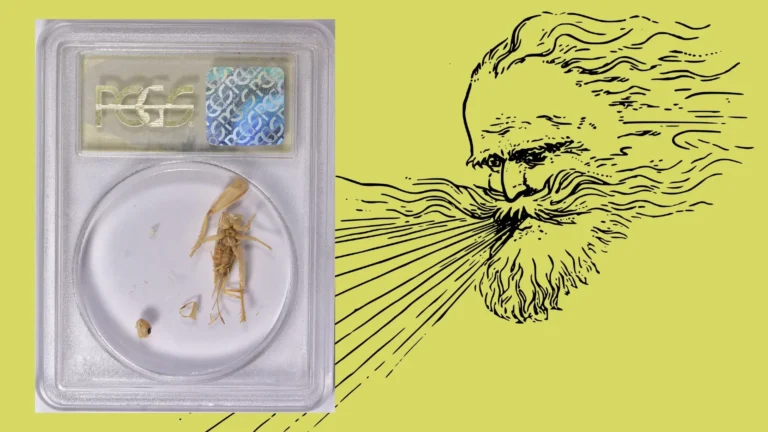
Today, we know that no, the pre-2015 holders are not airtight and yes, they let air in. And one of the ways we know this is tremendously strange: at PCGS, they caught a cricket and put it in a slab.
The Legend of the Cricket
Legend has it that in 1999 or 2000, a cricket sneaked into the PCGS grading offices. And it became so annoying that they had no choice but to catch it. After a few attempts, one of the employees managed to trap it inside a holder.
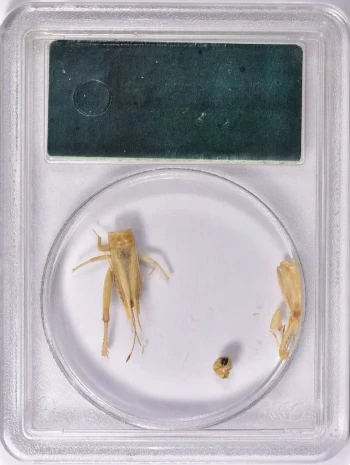
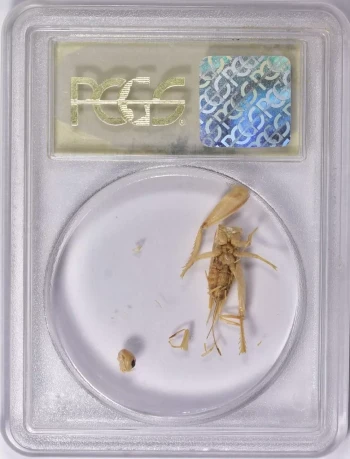
Here it is (photos from September 2021):
The front (Photo: Great Collections).
The back (Photo: Great Collections).
Now the problem shifted: what could they do with a holder with a cricket inside?
After a meeting with the bosses, it was decided to give it as a present to one of the foremost experts in numismatic errors in the United States, Fred Weinberg.
You can listen to Weinberg himself telling the story here:
Since then, Weinberg has carefully kept it, and he has rarely shown it in public: in 20 years, he has only taken it to a couple of American numismatic conventions, and it has received a mention in David Schwager’s Sample Slabs holder label catalog.
Page 394 of “Sample Slabs”, featuring the holder with the cricket.
In 2021, the slab with the cricket was finally auctioned off at Great Collections. The hammer price was $5,350.
Preservation of the corpse and the non-airtight slab
If you compare the photos from the book page with the auction photos, the first thing that stands out is that the position of the cricket’s corpse is not the same. I believe this to be normal: a slab is made to hold coins, not crickets.
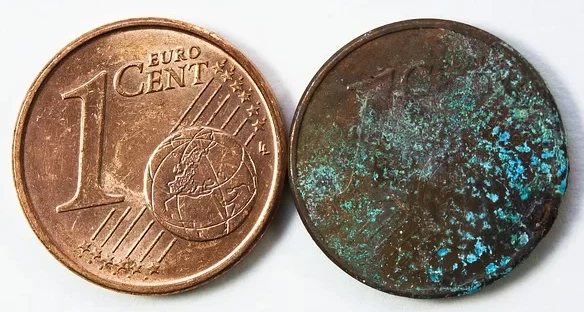
But if you look closely, it seems that the color of the cricket in the auction images is also darker than in the book. This indicates one thing: there has been a process of oxidation inside the slab. And oxidation occurs when a material is in direct contact with oxygen.
If you remember your high school chemistry lessons, or if you look at any banana peel you’ve thrown away, you’ll remember that organic material oxidizes much more quickly than inorganic material.
Regular 1 euro cent coin, and one that has undergone extreme oxidation (Photo: Pixabay/stux).
The cricket is organic material, while the metal with which any coin is made is inorganic. Therefore, the cricket gives us an accelerated view of the oxidation process that occurs inside the capsule, in the numismatic version of speeding up a Youtube video.
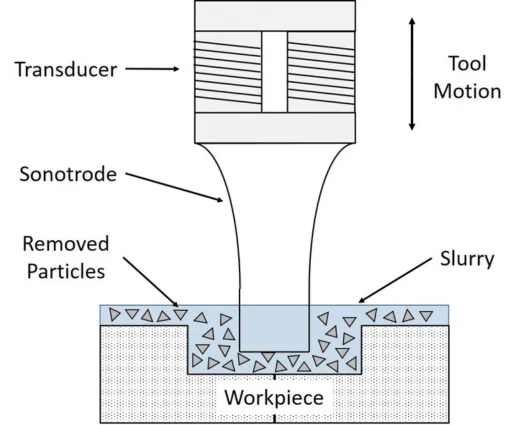
The conclusion of all this is that, indeed, the ultrasonic welding that seals both sides of a PCGS holder is not airtight and does allow air to pass through.
Diagram of the ultrasonic welding process (Photo: Commons/Four30).
In fact, Weinberg himself, in the video you can watch above, says that if someone were to attempt to break the ultrasonic weld to re-slab the cricket, it’s highly likely that the corpse would disintegrate due to oxidation and the force required to open the holder.
Reactions from NGC and PCGS
The NGC and PGCS holders are technologically similar but different in design, so these conclusions cannot be applied to the former.
But it’s not a problem, NGC itself already openly states in its FAQ that its capsules are not completely airtight either.
As for PCGS, in 2015 they introduced a new holder design. And they claim that, unlike the previous model, which is the one containing the cricket, this time they are “virtually airtight.” It remains to be seen what exactly “virtually” means.
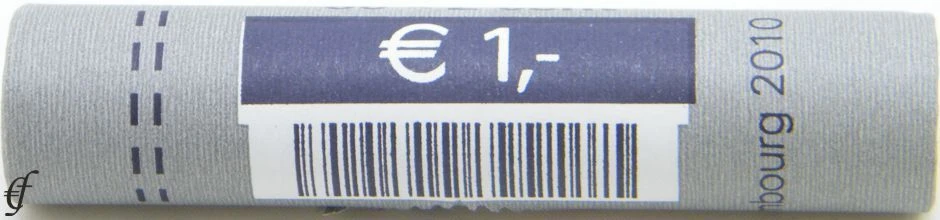
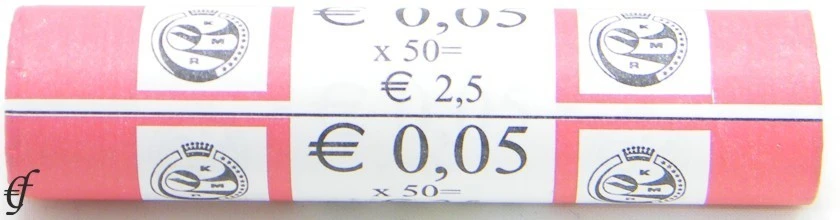
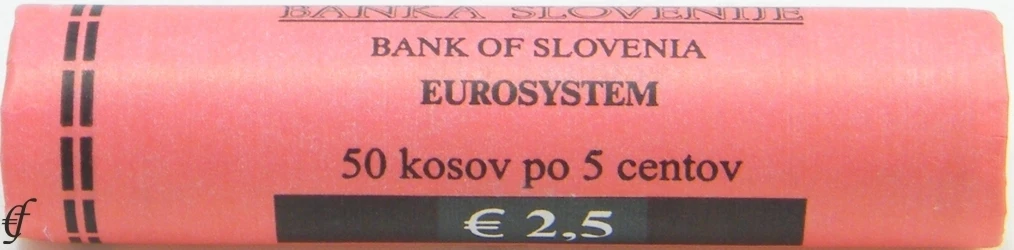
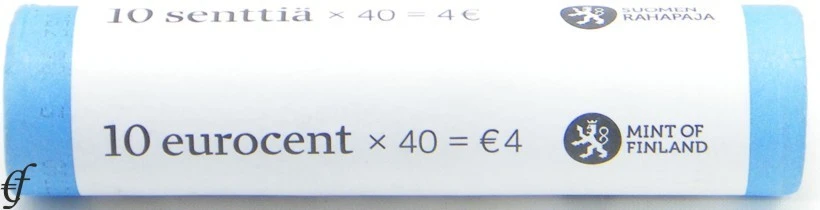
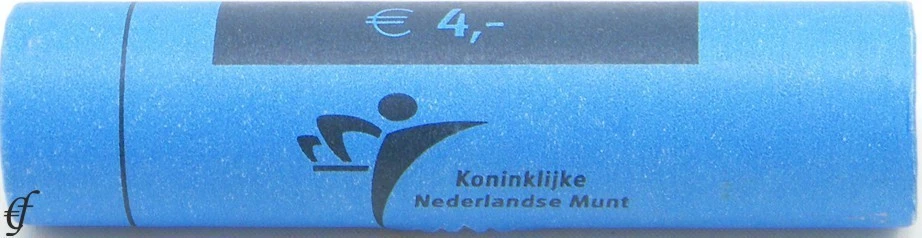
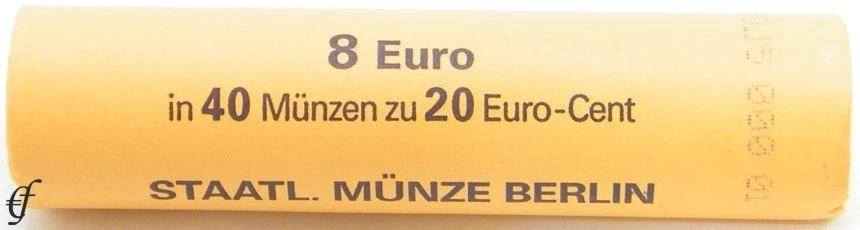
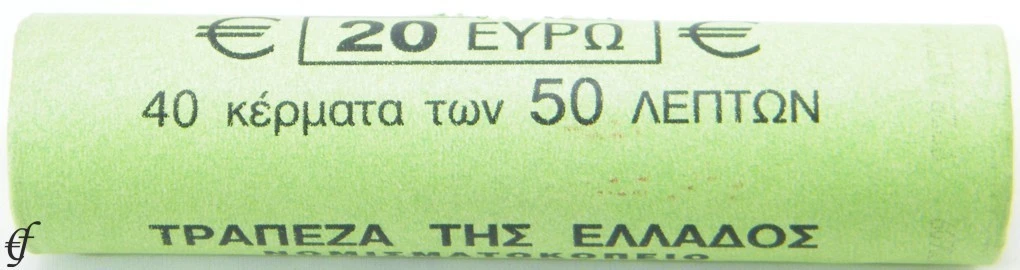
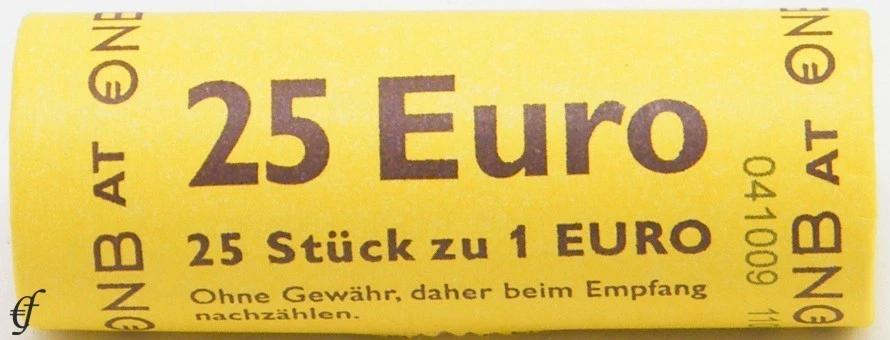
A couple of days ago, I stumbled upon a small curiosity that may be obvious. Something that some of those who read me might already know, but that I had never noticed: euro coin rolls have a standardized color code throughout the Eurozone, which also matches the color of euro banknotes.
This adds to something I did know, which is that the amount of coins per roll is also standardized.
This European standardization probably stems from some internal memo of the European Central Bank, but I haven’t been able to find which one. I’ve asked the Bank of Spain, my local central bank, to see if they can help me find it. As soon as they reply, I’ll post it here.
In the meantime, let’s see what colors they are, some examples, and, finally, some exceptions that could give us a clue as to when the ECB’s internal circular was issued.
The colors
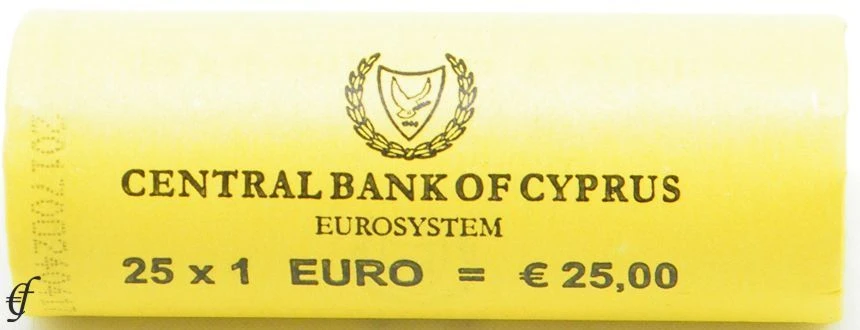
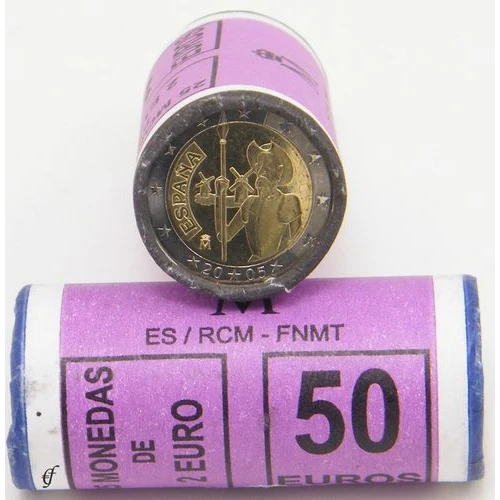
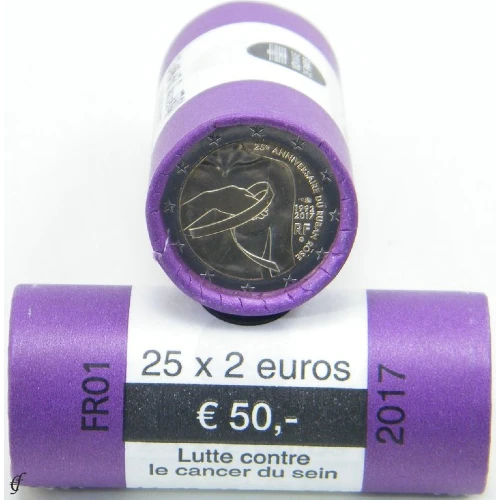
The colors of the rolls follow the same progression as the euro banknotes from highest to lowest, and they are:
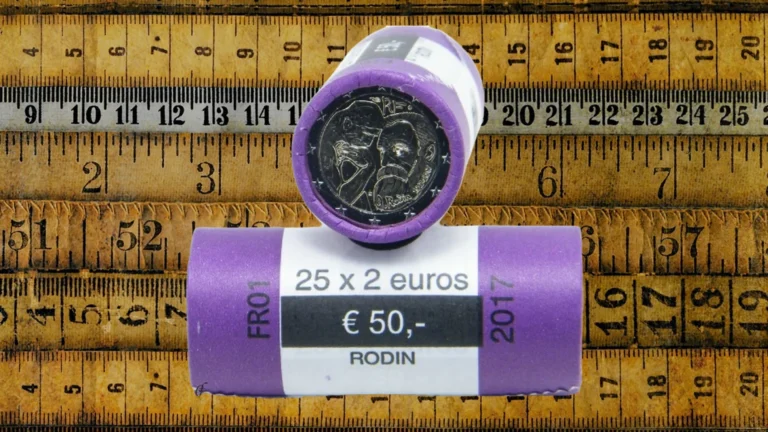
2 Euro Roll: Purple, like the 500 euro banknote
1 Euro Roll: Yellow, like the 200 euro banknote
50 Cent Roll: Green, like the 100 euro banknote
20 Cent Roll: Orange, like the 50 euro banknote
10 Cent Roll: Blue, like the 20 euro banknote
5 Cent Roll: Red, like the 10 euro banknote
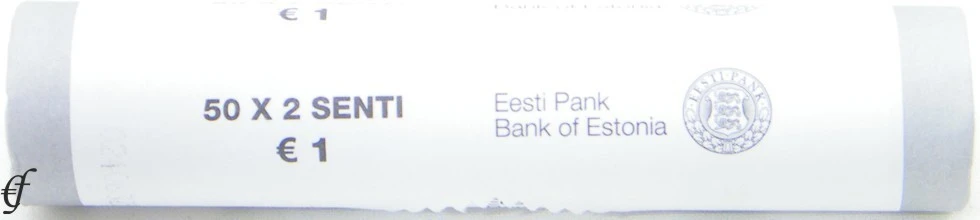
2 Cent Roll: Grey, like the 5 euro banknote
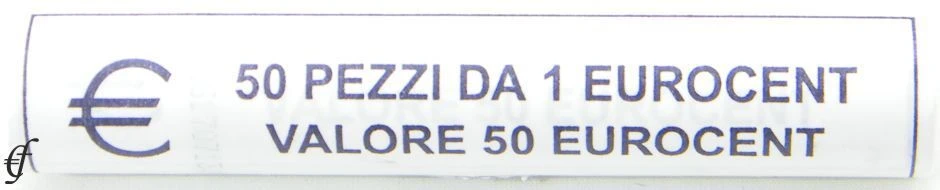
1 Cent Roll: White
Let’s see examples of each:
1 Cent Rolls
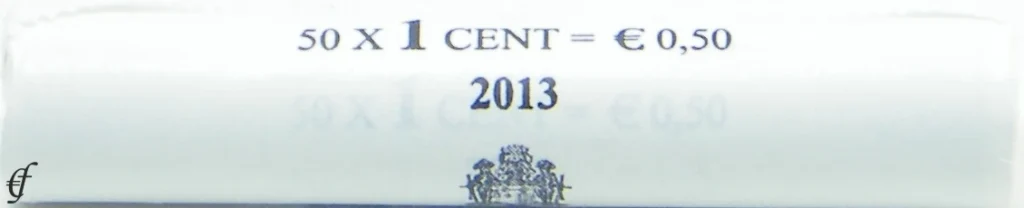
1 cent rolls contain 50 coins, totaling a value of 0.50 euros per cartridge. The identifying color is white.
As you can see, regardless of the country, the color code is there. However, while searching for images for this article, I have found two exceptions to these standard color codes and sizes, which could give us a clue as to when it was established.
The exceptions
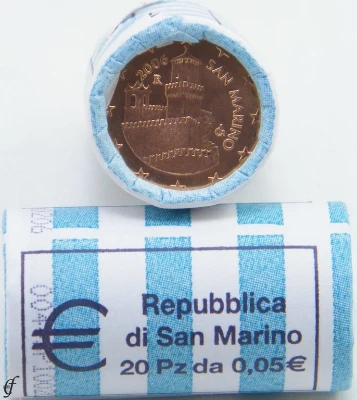
The first of the two exceptions are the San Marino rolls of 1, 2, and 5 cents from 2006, which are white with blue bands, regardless of the denomination. Additionally, instead of containing 50 pieces per roll, they only carry 20, resulting in a rather chubby appearance.
Roll of 20 2006 San Marino 5 euro cent coins (Photo: Eurofischer).
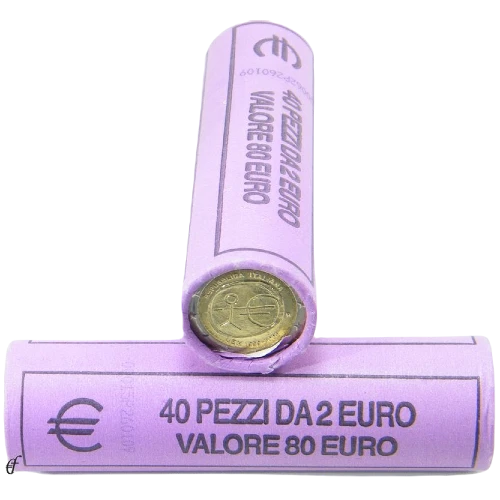
The second exception lies in the commemorative 2 euro coins from Italy between 2004 and 2009. Although they were already purple, the rolls contained 40 coins instead of the standard 25.
Roll of 40 2009 Italian 2 Euro Commemorative Coins dedicated to the Economic and Monetary Union (Photo: Eurofischer).
It was in 2009 when Italy made the change to the standard of 25 coins per roll. The first Italian 2 euro commemorative coin of that year, dedicated to the Economic and Monetary Union, still came in a roll of 40 coins. The second commemorative coin of 2009, in honor of Louis Braille, was the one that inaugurated the 25-piece cartridges for Italy.
With these two exceptions, my hypothesis is that standardization occurred at some point between 2007 and 2009. We’ll see what the Bank of Spain responds to my query.
In ColeMone, quite often, we dedicate an article to explaining basic concepts in a sort of numismatic glossary. Today we are looking at one of those basic things that, if you’re going to get into banknote collecting, you need to know for sure: what is, where to find, and who decides the Pick number (or code) of a banknote.
The Pick Number of a banknote is a number belonging to the classification system established in the various volumes of the Standard Catalog of World Paper Money, also called “Pick Catalogs,” and they are indicated with a “P.” Each type of banknote has its number, and the numbers for each country start with P#1.
The Standard Catalog of World Paper Money
The Standard Catalog of World Paper Money is the quintessential catalog of banknotes worldwide and serves as the global standard for classification, usually accompanied by another catalog at the country level. The first edition was published in 1975 and was the work of the German numismatist and banknote collector Albert Pick. Hence it is called the Pick number.
In its latest editions, the Standard Catalog of World Paper Money has been divided into three different volumes.
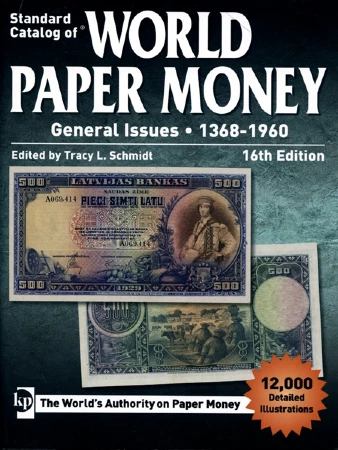
The first is dedicated to banknotes from 1368 to 1960. The latest edition, number 16, was published in 2016.
Cover of the Standard Catalog of World Paper Money, 1368 to 1960.
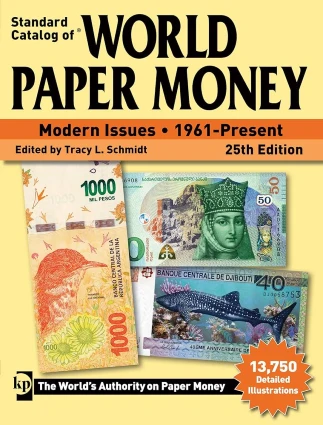
The second volume covers from 1961 to the present. The latest edition, number 25, was published in 2019.
Cover of the Standard Catalog of World Paper Money, 1961-Present.
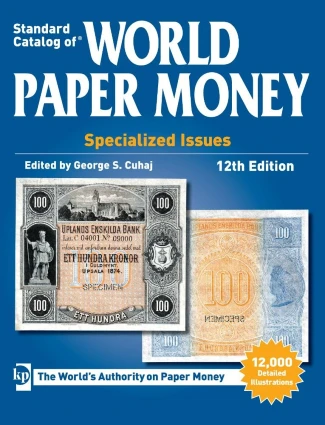
And the third volume focuses on specialized issues, such as local banknotes or issues for collectors. Its latest edition, number 12, dates back to 2012.
Cover of the Standard Catalog of World Paper Money, Specialized Issues.
Unfortunately, there may not be any more editions.
The company that published them, F+W, filed for bankruptcy in 2020, and its assets were auctioned off and bought by many other companies. The book publishing business was acquired by the giant Penguin Random House, and the numismatic and notaphilic magazine publishing business was acquired by the American publisher Active Interest Media, which would eventually also purchase Krause Publications from Penguin, thus taking over F+W’s entire numismatic segment.
Since then, there has not been a physical edition of the Standard Catalog. But that does not mean that the KM Code is dead.
Active Interest has maintained the spirit of the Pick Code on its Numismasterwebsite, which has a catalog of world banknotes. There, it’s called the SC Number (indicated as SC#), presumably for reasons of intellectual property rights. The process of assigning the SC is the same as that of the Pick.
Let’s look at that process.
How is the Pick number of a banknote assigned?
The specific algorithm by which a Pick number is assigned to a banknote is proprietary and, therefore, theoretically secret.
However, after many years of using these catalogs for classification, collectors have been able to identify certain patterns that have repeated over time.
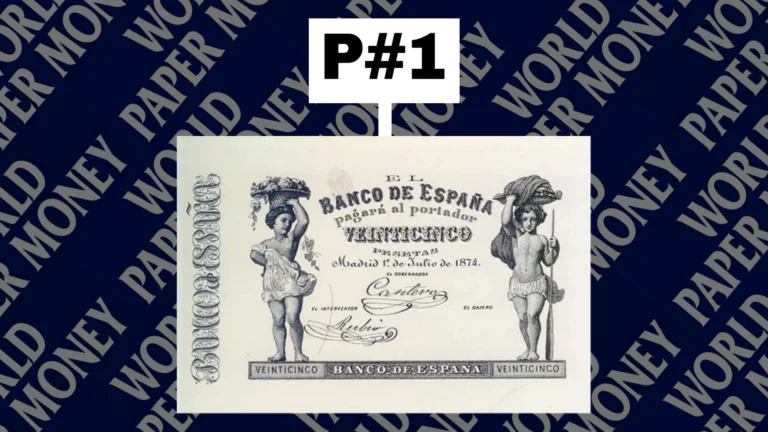
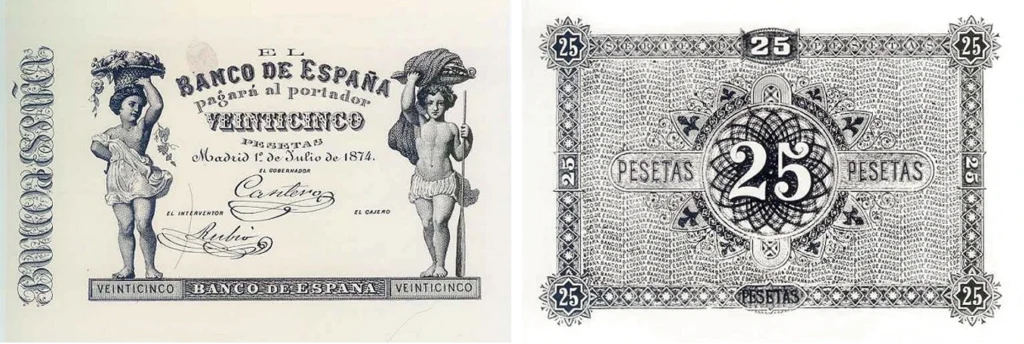
The banknote with the P#1 for Spain is the 25 pesetas from 1874 (Photo: Banknote.ws).
The Pick number is unique for each country. That is, there is a P#1 for Spain, another for China, another for Ghana… And within each country, banknotes are ordered by year of issue, first from oldest to newest, and then from lowest to highest denomination.
Prefixes
Sometimes, the Pick number has a prefix, like P#FX345. It always appears in uppercase, and the following ones may appear:
“A” and “B” prefixes (e.g., P#A123 and P#B123): For banknotes that were skipped in the original numbering and had to be added later. To avoid renumbering an entire country, these prefixes are introduced.
“CS” prefix (e.g., P#CS123): For collector’s editions.
“FX” prefix (e.g., P#FX123): For foreign currency conversion certificates.
“M” prefix (e.g., P#M123): For banknotes belonging to military issues.
“R” and “S” prefixes (e.g., P#R123 and P#S123): For specialized issues, such as local banknotes, private bank issues, notgeld, etc.
Suffixes
The Pick number can also have a suffix at the end, like P#123tc. Unlike prefixes, suffixes are in lowercase. The following suffixes may appear:
“a“, “b“, “c”, etc. suffixes (e.g., P#123a, P#123b, P#123c…): For each issue date of the same banknote.
“ct” and “tc” suffixes (e.g., P#123ct and P#123tc): For color trials.
“r” suffix (e.g., P#123r): For replacement banknotes and printed but unissued banknotes.
“p” suffix (e.g., P#123p): For proofs.
“s” suffix (e.g., P#123s): For specimens.
“x” suffix (e.g., P#123x): For counterfeits and errors.
Sometimes, a number may appear after the suffix. This means there are several versions of whatever the suffix indicates. For example, if we encounter the banknote P#345tc1, it would mean it is the first of several color trials of the banknote with Pick 345.
How to read the Standard Catalog of World Paper Money?
Once you know what the codes mean, reading and interpreting the Standard Catalog of World Paper Money correctly is not too difficult.
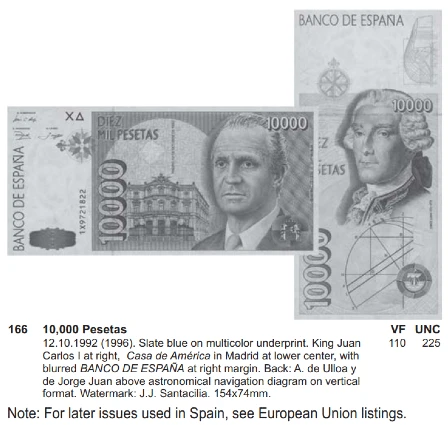
The last entry for Spain in the Pick Catalog: the 10,000 Pesetas banknote from 1992 (P#166).
Each banknote has its entry, and typically it includes a photo of the banknote (although not always), and below, its Pick number, denomination, description, and its values in dollars and in the Very Fine and Uncirculated grades of the traditional American grading scale.
Be cautious with the values
When reading the catalog, it’s important to be cautious with the values. It’s been quite some time since the last edition of each volume of the Standard Catalog of World Paper Money, and as of today, they may be quite outdated.
Even if the ones in Numismaster, which are supposed to be up-to-date, tend to reflect the state of the American collector market, which almost certainly will be vastly different from the market or the country you are reading this from (unless you’re reading from the US, of course).
It’s best not to take those figures literally. Rather, take them as an indication of which banknote is valuable and which one is not as much.
So, if you’re going to start collecting banknotes, that’s all you need to know about the Pick number. Let’s hope we have a new physical edition of the catalogs sooner rather than later.
A few weeks ago, I received a very interesting message from a Spanish reader who recently experienced a small numismatic setback from which a few lessons can be learned about bargains, counterfeits, and interactions with coin sellers.
Here is the message the reader sent me, which I reproduce with their permission and whom I will keep anonymous.
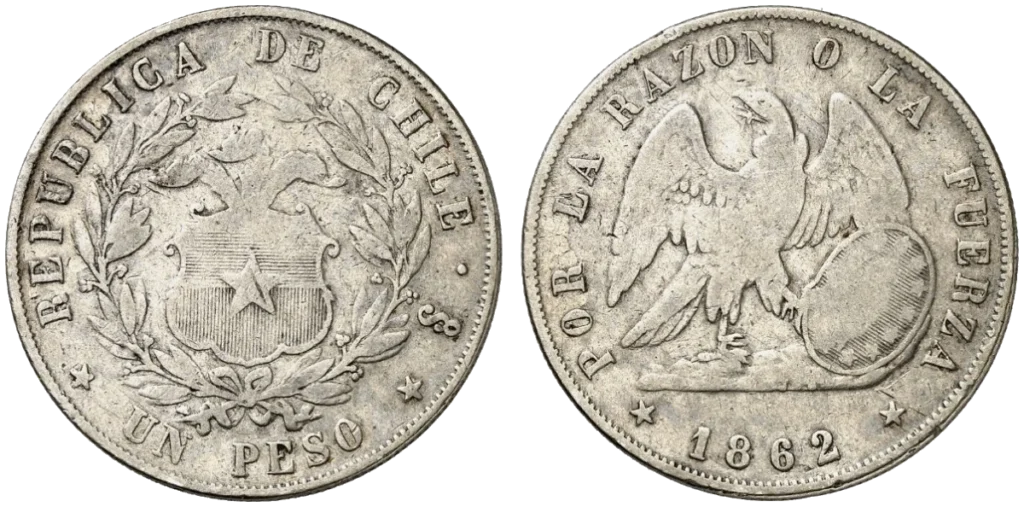
A few months ago, at a Sunday numismatic flea market in my city, while going through one of those cheap world coin boxes (where each coin was priced at €2), I found a 1 Chilean peso coin from 1862. For sentimental reasons, I felt compelled to buy it without knowing anything about it. At that price, I could afford the risk that comes with ignorance.
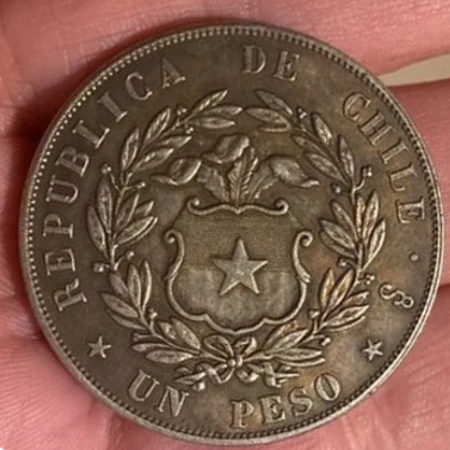
When I got home, I looked up information about the coin and saw that it was not only scarce but also made of silver. That, of course, made me very suspicious because the silver content alone would make it worth 14/15 euros. I checked the weight and diameter, and it matched. I tested it with a magnet, and it wasn’t magnetic. Although rationally I still suspected it was fake, I guess something inside me wanted to believe I had found a bargain. Beginner’s luck, I suppose.
Since one can’t live on hope alone and I wanted to know what I actually had, I contacted a Chilean coin shop who asked for photos of the coin. I sent them, and shortly after, they replied tersely and reluctantly that it was what it had to be: a counterfeit. They didn’t want to give me more explanations about why, at a glance in a photo, it’s clear that it’s a fake coin. I understand that it’s not their obligation to teach me anything, and perhaps they felt I was wasting their time.
Now I’ve seen the same coin being sold on AliExpress for 1.5 dollars as a reproduction.
My main question is:
Is it ethical to sell a forgery in a mixed coin box at a flea market, even at the price of the forgery, without specifying what it really is? Is it something to be expected? Should I avoid this stall at the flea market in the future? I think I should, but I’m interested in your opinion.
Counterfeits in coin boxes
I don’t know which specific seller our dear reader is talking about, but I can say that a majority of sellers who have boxes of inexpensive world coins usually don’t check them, or if they do, it’s very, very superficially.
The reason for this is a simple cost-benefit equation. Like in any other business, a coin shop has to maximize the profit it makes per hour worked.
Let’s say that cataloging a regular coin and verifying that it’s not a counterfeit takes you 5 minutes. That means, in an hour, you can process 12 coins. And let’s also say that your profit margin is 20% (this is an example, each seller will have their own margin).
The 1 Chilean peso coin from 1862 (made of .900 silver, weighing 26 grams, with a diameter of 33 millimeters) had a minting of 103,000 pieces. It is quite a rare coin to find, and almost impossible to come across in high grades (Photo: Herbert Grün – Auction 66, Lot 1102).
If you invest that time in a coin that you’re going to sell for 2 euros, a 20% profit margin means you will earn 40 cents on that piece. With this calculation, if you look at 12 coins in an hour, your profit per hour of work will be 4.80 euros.
And a profit of 4.80 euros per hour is totally unsustainable in any business. If you do the math, you’ll see that it’s even quite below the minimum wage in many countries.
Therefore, it’s normal for a merchant to focus their limited time on more valuable coins and invest little to no time in these coin boxes. They will need to focus on pieces that yield a higher return, which brings them closer to the profit per hour goal that their business plan has set as the minimum for their store to be economically viable.
Moreover, with these calculations in hand, you might even find it normal that there are counterfeits in those cheap coin boxes. Therefore, I wouldn’t worry about it, and much less cross off the seller from my list if they sold you one from that box and it turns out to be fake (the situation changes if it’s a more significant and valuable coin, of course, but that’s a topic for another day).
Why do they put them there?
Reading this, you might be wondering why sellers bother to even have one at their stand or store if the profit from those cheap world coin boxes is so meager.
Each seller will have their particular answer to that question, but I (who am not a seller, just some guy with a blog) think there are two major intangible benefits to placing one of these boxes at your stand.
The first is to get those who are starting to collect used to buying from them.
It’s rare for someone who has been collecting for a few months to spend hundreds of euros on a coin. However, that person does have the potential to do so in the future, as their collection evolves. If that person has bought coins from you for 20 cents or 2 euros and is happy with the piece and the service you’ve provided, it’s quite possible that you’ll be one of the first options if one day they want to buy a coin for 200 or 2000 euros.
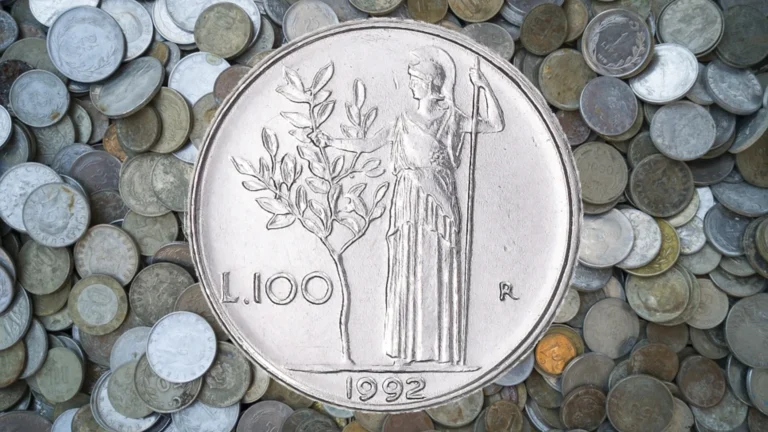
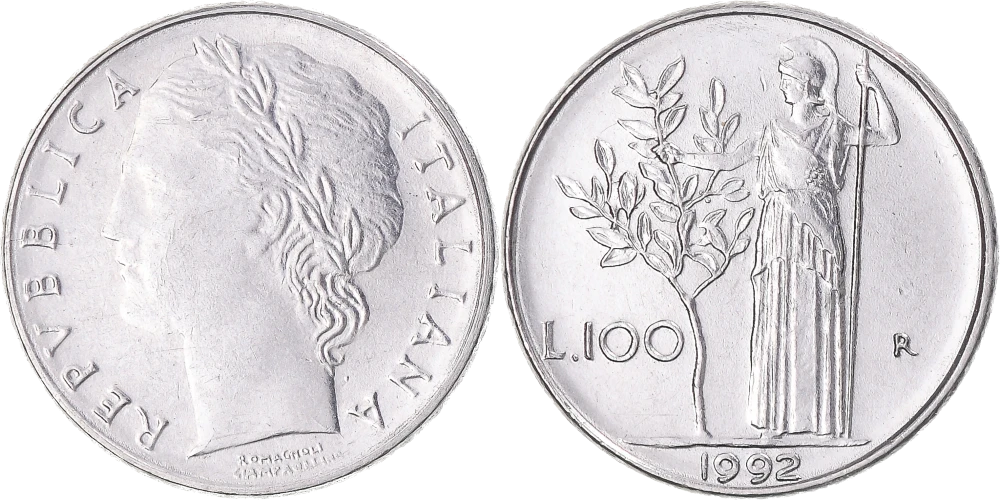
The 100 Italian lira coin is a classic in those cheap world coin boxes (Photo: vCoins/Numiscorner).
The second is to be a point of creation for new collectors.
It often happens that someone who doesn’t collect coins comes across a Sunday flea market and starts looking around out of curiosity, or just to pass the time. And who knows, maybe they don’t buy anything. Or maybe, for whatever reason, they find a coin in the 20-cent box amusing. Or maybe they go with their child, and the child likes it. So they decide to buy it, after all, it’s just 20 cents.
Perhaps the coin ends up stored in a drawer until who knows when. But it’s also possible that this 20-cent coin becomes the seed of a new collection and a new collector. And their first numismatic memory is going to be buying that coin from you. From a marketing standpoint, that’s very powerful. I perfectly remember where I bought my first coin, and to this day, I visit their website more or less regularly.
But let’s get back to the reader’s email.
The Other Three Lessons from the Reader
Equally or more interesting than the question our reader asks is the context they provide. From there, we can draw three more lessons:
Lesson 1: In numismatics, bargains rarely exist
Our reader mentions being excited to see that the coin they had bought for 2 euros could be worth much more.
Normally, if a coin is too cheap, there’s something odd about it. In fact, it’s one of the classic symptoms that indicate we might be dealing with a counterfeit coin.
This is the photo the reader sent me. If you compare the “R” in “Republic” with the photo of the original coin from above, it’s sure to give you a very bad feeling.
It’s possible that a seller might have made a mistake in cataloging that coin and priced it much cheaper than the market value. It’s not the first time it has happened, it won’t be the last either, but it’s extremely rare.
However, what we cannot do is assume that we, collectors with very limited time to learn and research, can outsmart someone who is professionally dedicated to numismatics. Can it happen by sheer luck sometimes? Sure. Is it common? Not at all.
It’s true that our dear reader did not buy the coin because it was a bargain, but for sentimental reasons, yet they should still feel lucky: this lesson, which almost all of us receive at some point when we are numismatic rookies, only cost them 2 euros. In my case, it cost me 10. And I’ve met people who paid much, much more.
Lesson 2: Choose the moment and the question
One of the things I liked about the reader’s email is that it shows a level of reflection and self-criticism that I rarely find in those who write to me.
The reader mentions that they wrote to a Chilean numismatic to ask if the coin was genuine. The numismatist replied that it was not (reluctantly, according to the reader), but did not provide further details. And instead of getting angry with them for not answering all their questions for nothing in return, the reader realizes that “it’s not their obligation to teach me anything, and perhaps they felt I was wasting their time”.
Bravo.
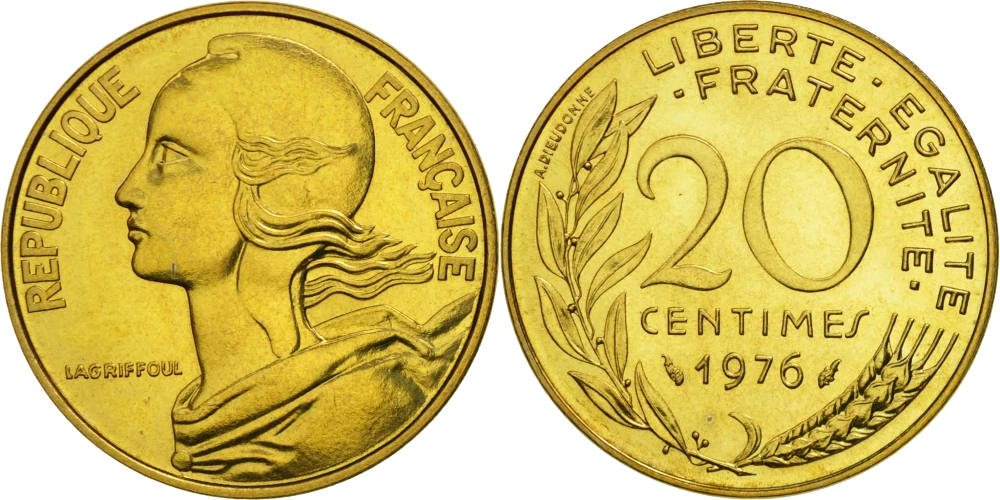
The 20 French centimes from 1976, another great classic of the box (Photo: vCoins/Numiscorner).
Sometimes we forget that numismatic shops are also businesses. Unless they are very busy or attending to another customer, sellers usually have no problem responding to questions or doubts about the coins they have for sale.
But to ask whether this or that is fake, when you have no intention of buying anything there, is basically taking advantage of a professional’s knowledge for free, of a person whose business depends precisely on those insights. It’s the equivalent of calling your local electrician and saying… “My plug doesn’t work, how do I fix it without paying you?” Logically, the electrician will tell you to get lost.
It’s a different matter when you’ve paid for some coins. In my experience, if I’ve bought a piece from them and at the end of the transaction I think of a question about any coin, even one that they don’t have for sale, a seller will generally have no problem answering it.
Lesson 3: Ignorance comes at a cost
In numismatics, there is a maxim that comes from time immemorial: “First the book, then the coin.”
This phrase, as clichéd as it is full of truth, means that to avoid getting into sticky situations with coins, it’s better to acquire enough knowledge to know what we’re buying.
Our reader, despite making a textbook impulse purchase, seems to keep this in mind and tells us that “for that price, I could afford the risk that ignorance entails.” Good for him.
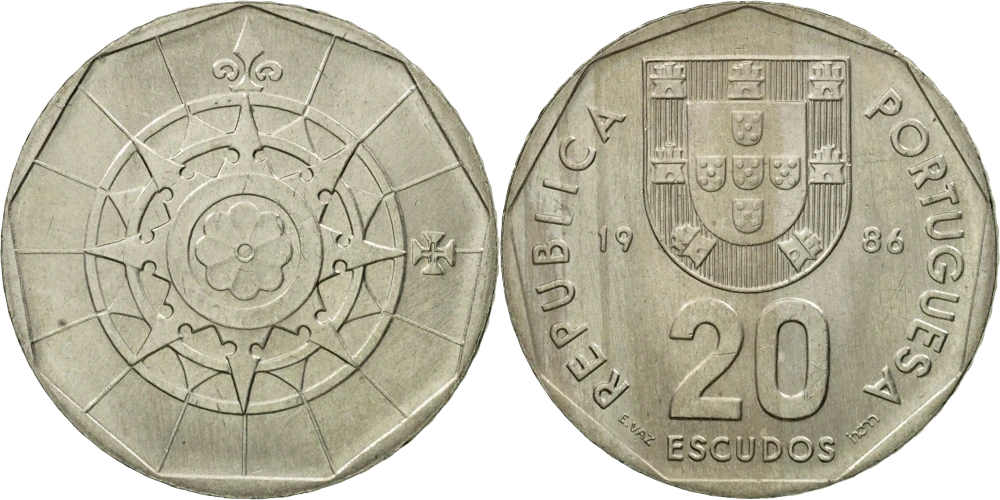
The 20 Portuguese escudos complete the podium of box classics (Picture: vCoins/Numiscorner).
And the fact is, when it comes down to it, being sure that the coin we have is genuine comes at a price, which we have to pay in one way or another. And there are three ways to pay:
Pay with money to experts who know more than we do and who can guarantee the authenticity of a coin.
Pay with money for a coin without knowing anything about it, risking throwing it away if it turns out to be fake.
Pay with time, using it to acquire enough knowledge to distinguish a fake from a good one, and, along the way, enjoy the study.
In the end, numismatics, just like life itself, is a tug of war between time and money. You decide how to balance them. I, for one, have it crystal clear.
If there’s one thing about numismatics, it’s the vast amount of specialized terminology that can be hard to grasp when you’re starting in the field. So, little by little, we’re going to look at the meaning of those words. Today, it’s time to see what the KM number of a coin is, who decides it, and how and where to find it.
The KM number, of a coin (an acronym for Krause-Mishler) is a code belonging to the world coin classification system originally established in the various volumes of the Standard Catalog of World Coins, the so-called “Krause Catalogs”, and which today is published on the Numismaster website. Each type of coin has its own number, and the numbers for each country start with KM#1.
The Standard Catalog of World Coins (and its demise)
Or, if you go to many coins auctioned at Heritage, it will also appear. Any from, say, Tauler&Fau, and there it is again. And I could continue with many of the most prestigious auction houses, and follow up with the less prestigious ones.
That’s because the KM number is the global standard for classifying world coins issued since the 16th century. Almost all professionals and collectors use that code, usually supplemented with a national catalog’s, like the CJ in Argentina or the Red Book in the US.
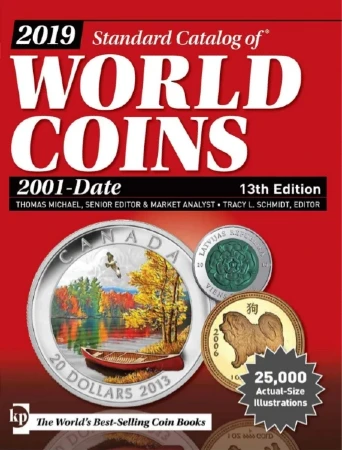
Cover of the 21st century Standard Catalog’s very last edition.
From its establishment in 1972 until its last edition in 2019, the KM was featured in the Standard Catalog of World Coins, published by F+W Media through its Krause Publications imprint.
The Standard Catalog is divided into 5 volumes, ranging between 1600 and 2500 pages each, covering roughly a century of world coins. The volumes that cover the 20th and 21st centuries were updated annually, while the books covering earlier centuries had a slower and more irregular publication pace.
The Death of the Standard Catalog
However, since the fall of 2019, no new edition of any of the 5 volumes has been published, and there seems to be no plans to continue doing so.
The reason for this is that, in March of that year, F+W Media declared bankruptcy.
This bankruptcy, truth be told, was foreseeable. In the last two or three years, the pace of assigning KM numbers had dropped significantly, with delays of 4 or 5 years from the issuance of the coin to the assignment of its number, especially in smaller countries. This happened for two reasons:
1- On the way to bankruptcy, there were layoffs at the company. With fewer employees, it was necessary to prioritize the assignment of codes, with the larger countries and those with more catalog sales going first, especially Germany, Italy, the United Kingdom, Canada, and the United States. And, after those, they’d work on whatever coins there was time for.
2- Before the financial problems, Krause had collaborators all over the world, who, although they were not part of the salaried staff, contributed a lot to the cataloging process. I’m not exactly sure why, whether by the collaborators’ decision or the company’s, but many of them had reduced their contributions or had directly stopped contributing.
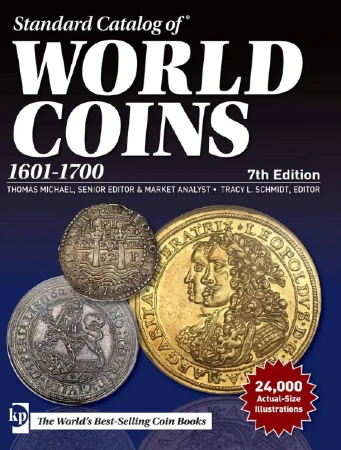
Cover of the 17th century Standard Catalog’s very last edition.
The bankruptcy declaration by F+W was accompanied by a court order to auction off the company’s assets to pay off debts.
And the entire F+W book division, including the Krause Publications imprint, was bought by Penguin Random House, one of the largest publishers in the world. Meanwhile, the numismatic magazines (along with other collectibles magazines) were acquired by a small Colorado publisher called Active Interest Media, which would eventually also purchase Krause Publications from Penguin, thus taking over F+W’s entire numismatic segment.
Since then, there has not been a physical edition of the Standard Catalog. But that does not mean that the KM Code is dead.
Where and How to Look Up the KM of a Coin: Numismaster
Aware of the worldwide importance of KM Codes, Active Interest Media has decided to adapt them to the 21st century and transition them from paper to digital.
This is how Numismaster was born, a website that serves as a database intended to replace the original catalogs and that, in addition to the KM numbers, also includes Pick numbers, the equivalent for banknotes.
On Numismaster, you can view the KM codes for free, and they are updated quite often. However, if you want to know the values, which was the other major contribution of the physical catalogs, you will have to pay for a subscription that will cost you between $7.50 and $15 per month, depending on the level of access you want.
But let’s be honest, Numismaster is neither a pretty website to look at nor easy to use. So allow me to write a short tutorial on how to look up the KM of a coin there:
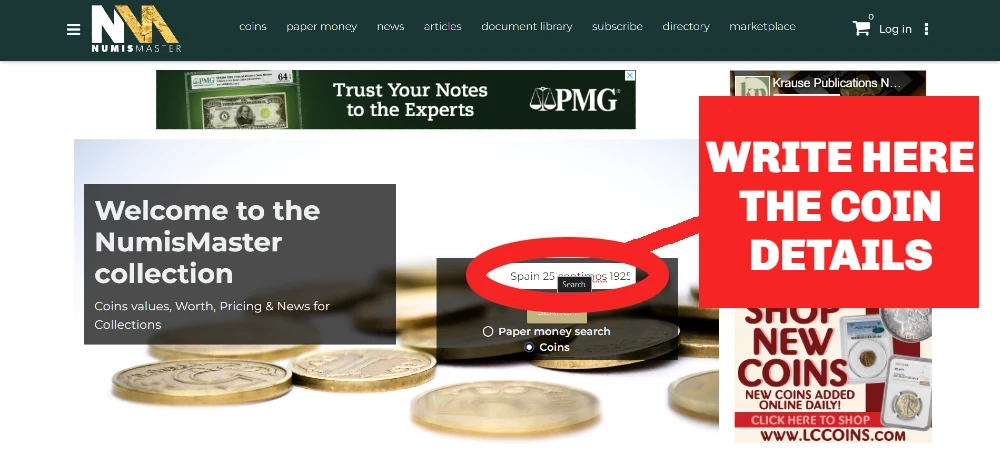
Step 1: Search
More or less in the center of the screen, you will see a box that says “Search coins…”. Type the details of your coin there. My recommendation is to write the name of the country in English, the denomination as it appears on the coin, and the year, and then hit the “Search” button.
Let’s use as an example the Spanish 25 cents from 1925, nicknamed “La Caraba”:
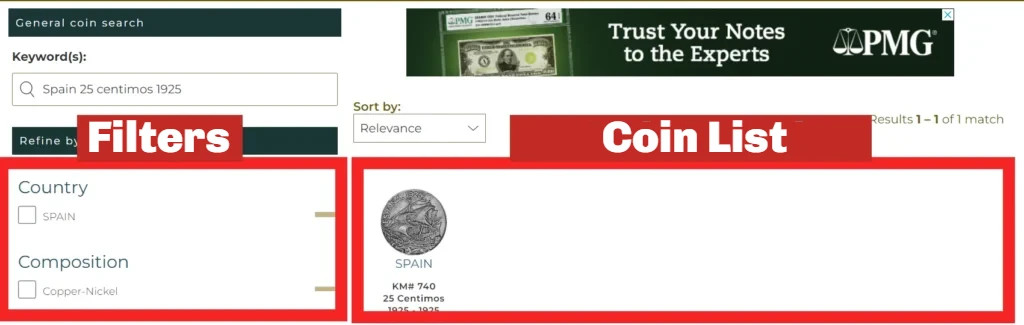
Step 2: Select
After waiting a bit while the system searches for results, a new screen will appear with a list of coins that might match what you’re looking for. Click on the one you want to know more about.
If the list is very large, you can filter by country or metal. However, if you search as I instructed above, this will almost always be unnecessary, as you can see in my example search.
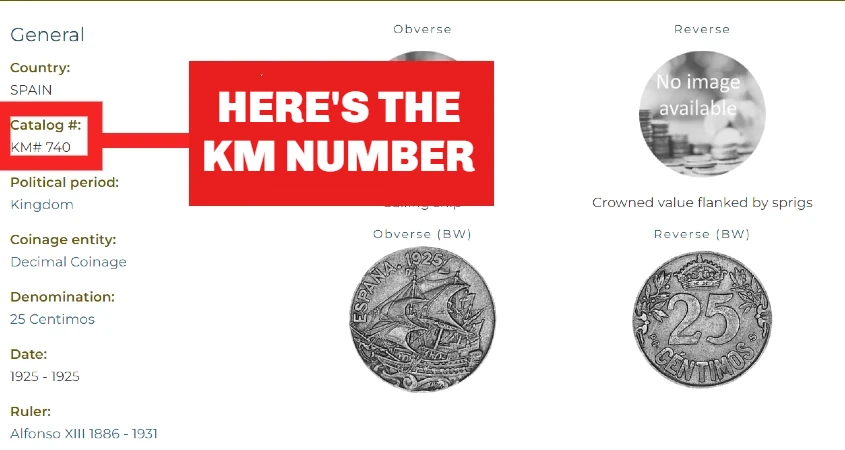
Step 3: Verify
After clicking on your coin in the list, Numismaster will take you to its individual record. In the right-hand column, you will finally be able to see the KM.
If you continue scrolling down the screen, you will see more data in the right-hand column, as well as the values in several conservation grades (if you have a subscription) and other related coins.
And now that we know where to look up the KM and who assigns it, there’s one last thing to find out: how it is assigned.
How is the KM Number of a Coin Assigned?
The specific algorithm by which a KM number is assigned to a coin is proprietary, and therefore secret, but we do know that it has barely changed in the transition from paper to digital. And after so many years of using these catalogs to classify their pieces, collectors have been able to identify certain patterns that have been repeated over time.
The KM number is unique for each country. Within each country, coins are sorted by type and not by year, first from oldest to newest, and then from lowest to highest denomination.
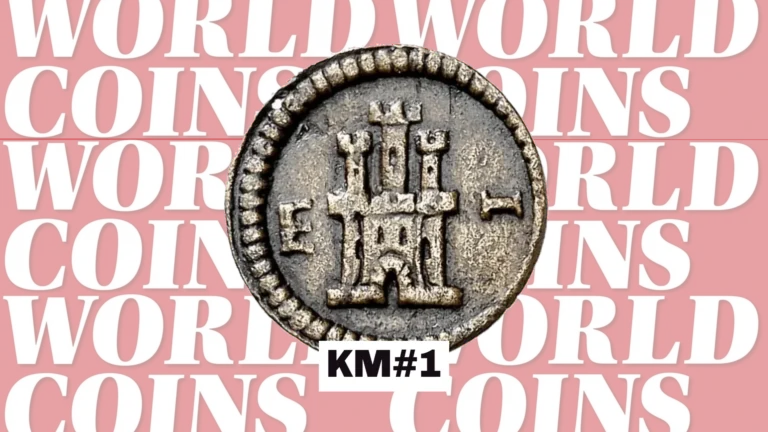
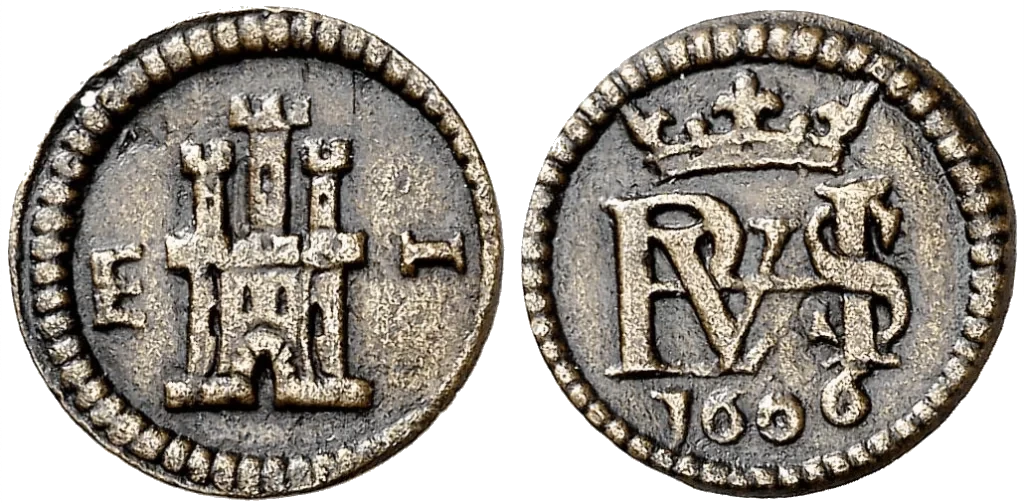
Spain’s KM#1 is this 1 maravedí coin issued in 1606 under King Philip III (Picture: Aureo & Calicó).
When the design of a coin changes in a significant way, a new KM number is assigned to the piece. If the variation is minor, then a sub-number is added, separated by a dot.
For example, the Spanish 1 maravedí coin that you can see in the photo above can be found with two mint marks: Cuenca and Segovia. As the variation in design caused by the different mint marks is not very significant, those minted in Cuenca are KM#1.1, and those minted in Segovia are KM#1.2.
If there are two pieces with the same design but the coin’s metal changes, then a letter is added to the end of the KM number.
As an example, Germany changed the material of the 2 pfennig coin in 1967. It went from being made of bronze to being made of copper-coated steel. The bronze ones are KM#106, and the copper-coated steel ones are KM#106a.
It’s also possible that a coin does not have a KM number assigned to it. This usually happens for two reasons: either the authors have not gotten to it yet, or it is not a real coin and rather belongs to the field of exonumia.
C# or Y# Numbers
Or it might be that instead of a KM, there’s a Y# or C# number, as it happens with the Russian coins.
The reason for this change is that the Krause catalogs incorporate, for certain countries, the classification works of previous authors. The “Y” corresponds to Richard S. Yeoman, and the “C”, to George Cuhaj. Maintaining these codes is a way to credit the original author’s contribution and, at the same time, to honor them.
In the end, the KM number is not strictly necessary to enjoy the hobby and your collection. But it is so prevalent and so widely used that it’s very convenient, at the very least, to know what it is.
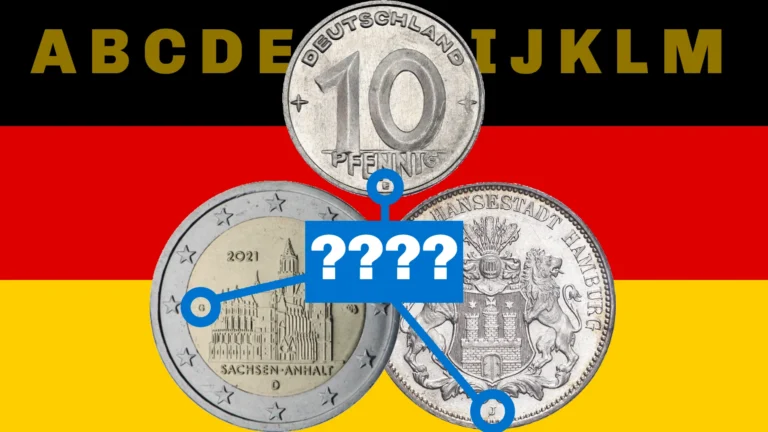
If you look at any modern German coin, in addition to the “D” indicating it comes from Deutschland, there’s another letter: A, D, F, G, and J. These are the German mint marks. But the selection of these letters seems a bit random, doesn’t it? Why isn’t there a C, or E? Today, we’ll see where these letters come from, how each German mint got its own, and what happened to the ones they skipped.
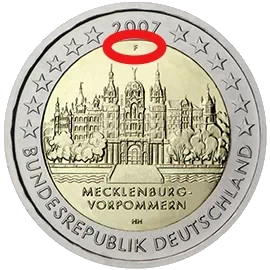
2007 2 euro commemorative coin from Germany with the mint mark “F”, from Stuttgart.
The mints of Germany that still exist
Today, Germany has five mints producing coins. It is, by far, the country in the European Union with the most mints, and the one that strikes the most euro coins.
Each of the five German mints is assigned a letter, which serves as an identifying mark of where the coin was manufactured. They are:
A: Berlin
D: Munich
F: Stuttgart
G: Karlsruhe
J: Hamburg
The Stuttgart and Karlsruhe mints belong to the same company, the Staatliche Münze Baden-Württemberg (State Mint of Baden-Württemberg), while the Berlin, Munich, and Hamburg mints are independent companies.
As you may have noticed, there seems to be a somewhat alphabetical order used, but it is neither complete nor sequential. And you might be thinking… why such a mess? Why not use the initial of the city and label them B, M, S, K, and H?
How each German mint got its letter
Well, as with almost everything in numismatics, to understand why they use that non-sequential alphabetical order, we have to go back a few centuries.
Let’s travel to Prussia in the year 1749.
The beginning of the system: Berlin earns its A
In 1749, Prussia had seven mints: Berlin, Breslau, Cleves, Aurich, Königsberg, Magdeburg, and Stettin.
They were privately owned, minting currency for the state through contracts. As you can imagine, having the entire monetary production of your country in private hands is not advisable at all.
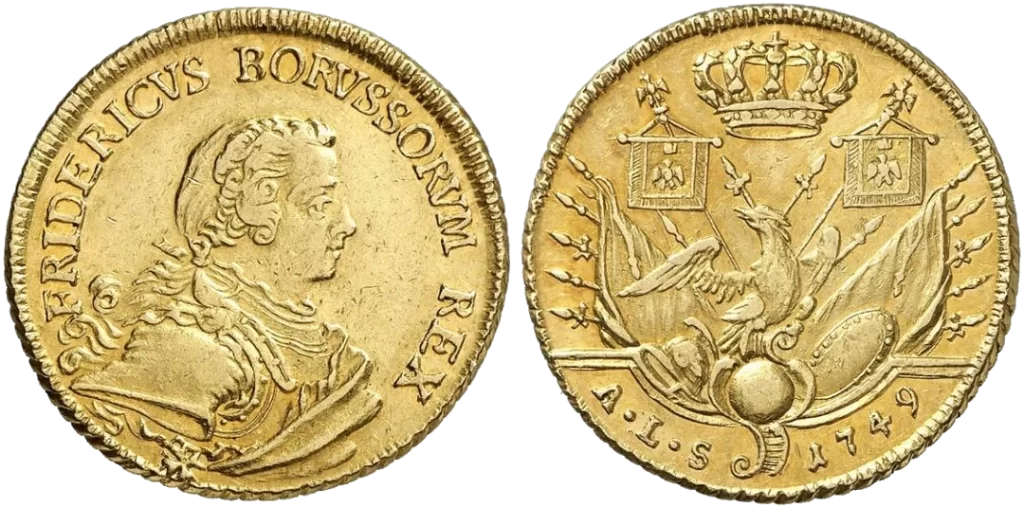
A Friederich d’Or minted in Berlin, Prussia, in 1749. No trace of a mint mark (Picture: Künker – Auction 250, Lot 2602).
So, in 1750 and 1764, advised by the mint director Johann Philipp Graumann, King Frederick II the Great implements two major reforms in the production of Prussian coins.
What these reforms do, basically, is to nationalize the mints. They stop being privately owned and become property of the Prussian state. And to make it clear, the mint marks are changed from being the private mark of the mint director in charge at that moment, to being a letter in alphabetical order, which would not change even if the bigwig of the mint changed.
The sequence chosen for the assignment of letters was the order of nationalization of the mint.
A: Berlin
B: Breslau (today Wroclaw, in Poland)
C: Cleves
D: Aurich
E: Königsberg (today Kaliningrad, in Russia)
F: Magdeburg
G: Stettin (today Szczecin, in Poland)
A Prussian Mariengroschen (also called a half Friederich d’Or) minted in Aurich in 1756. The “D” mark is below the year (Picture: Sincona – Auction 46, Lot 125).
Over time, some of these mints closed down, leaving their letter vacant. For example, in 1818, a mint was opened in Düsseldorf, which inherited, not so coincidentally, the D from Aurich, which had shut down in 1763. And others, well, they were conquered, like Hannover, which would carry the “B”.
From Prussian Mint to German Mint
On January 18, 1871, following his victory in the Franco-Prussian War, King Wilhelm I decides to rub some salt in the wounds of the French by proclaiming the creation of the German Empire in the Hall of Mirrors at the Palace of Versailles.
“The Proclamation of the German Empire” by Anton Von Werner. The French would take their revenge by very deliberately making the Germans sign the dissolution of their empire in 1919 in that same Hall of Mirrors at Versailles (Photo: Commons/Bismarck Museum).
On that very same January 18th, four different currencies were in circulation across the territories that made up the new German Empire, resulting from various treaties among the myriad of bishoprics, duchies, kingdoms, and Hanseatic cities that formed the Zollverein, the customs union of German states implemented in 1834:
The Vereinsthaler, used in the north of Germany, including Prussia.
Although these coins were not directly interchangeable, those treaties signed since 1834 had established equivalences in weights, fineness, and measures, which, with the advent of the Empire, allowed for a quick transition of the monetary system towards complete unification.
And on December 4, 1871, that is precisely what happens: the German Mark is born.
Wilhelm I orders the minting of 10 and 20 Mark gold coins that will serve as the basis to establish a complete monetary system based on them. And with those coins, he does two things: he abandons the silver standard to adopt the gold standard, and for the first time in Germany, implements the decimalization of the currency, with 1 Mark equaling 100 Pfennig. Its circulation would begin in 1872.
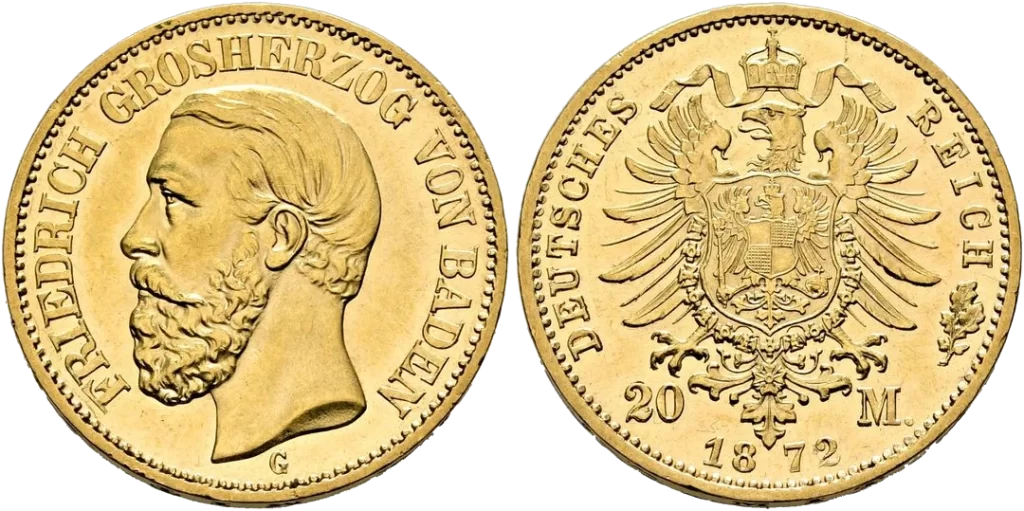
20 German marks from 1872 issued by the Grand Duchy of Baden, with the letter G from Karlsruhe below the bust. The German mark of 1871 worked just like the euro, there was a common face for all the German states (the one with the eagle), and a “national” face, in which each state put whatever they wanted. Baden chose the bust of its Grand Duke Frederick (Picture: Rauch – Auction 116, Lot 338).
In 1873, the next step is taken: the monetary cone of the German Imperial Mark is established, and a deadline is set for the disappearance of the rest of the currencies (except for the Vereinsthaler, which remains for international trade): January 1, 1876.
Who is going to mint all those coins?
One of the major debates about the currency of the new empire was who exactly was going to mint all the coins needed for the transition: whether it would be the German Empire or each of the states that made it up. Traditionally, coin minting had been one of the major rights of the states that made up the Holy Roman Empire.
So, after much discussion, negotiation, and controversy, it was finally decided that the states themselves would mint the coins, under guidelines provided by the bureaucratic apparatus of the Empire.
And which states would mint them, specifically? Well, all those that wanted to, voluntarily. And seven states wanted to: Prussia, Bavaria, Saxony, Württemberg, Baden, Hesse, and Hamburg. The decision that each could mint if they wanted was accompanied by the adoption of the Prussian-style mint marks, with a single letter.
That order is not random, by the way. It’s the order in which they appear in Article VI of the German Constitution of 1871, arranged from largest to smallest according to the number of votes they had at that time in the Bundesrat, the upper house of Germany.
The rest of the letters for the German mints
This constitutional order precisely determined which German mint carried which letter. Since Prussia and its provinces appeared first on the Constitution’s list, their mints would carry the first letters. Bavaria was second, so it would carry the next letters. Saxony was third, so it would carry the letters after Bavaria. And so on.
This is the list of German mints as established in 1871, the state they belonged to, and the order of that state in the 1871 Constitution:
A – Berlin (Kingdom of Prussia, 1st)
B – Hanover (Province of Hanover in Prussia, 2nd)
C – Frankfurt (Province of Frankfurt in Prussia, 3rd)
D – Munich (Kingdom of Bavaria, 7th)
E – Dresden until 1887, then Muldenhütten (Kingdom of Saxony, 8th)
F – Stuttgart (Kingdom of Württemberg, 9th)
G – Karlsruhe (Grand Duchy of Baden, 10th)
H – Darmstadt (Grand Duchy of Hesse, 11th)
J – Hamburg (Hanseatic City of Hamburg, 30th and last)
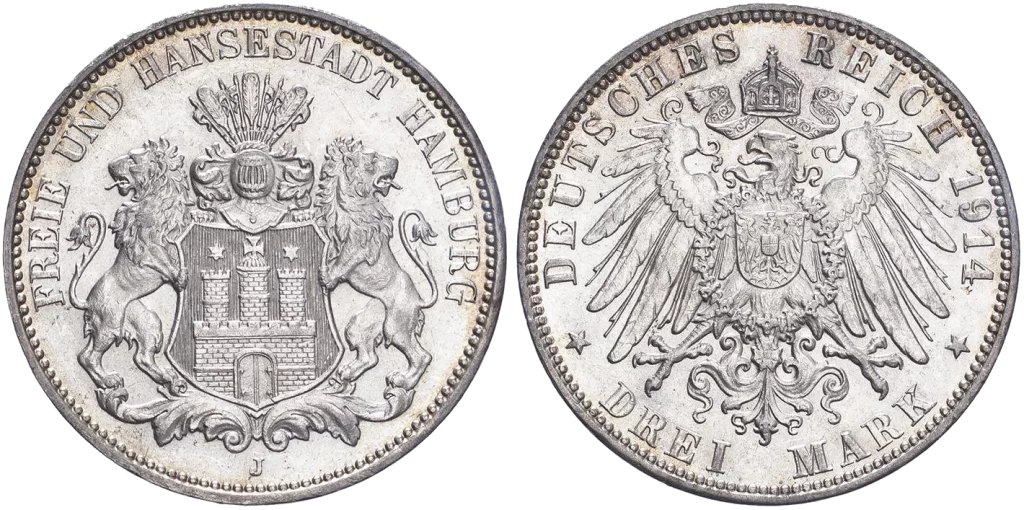
3 marks issued by the City of Hamburg in 1914. The J mint mark, from Hamburg, is below the city’s coat of arms (Picture: The Coin Cabinet – Auction 10, Lot 321).
The letter I was not used because it could be easily confused with the letter J, and there were plans to use the letter K as a mark for Strasbourg after the annexation of Alsace-Lorraine, but never materialized.
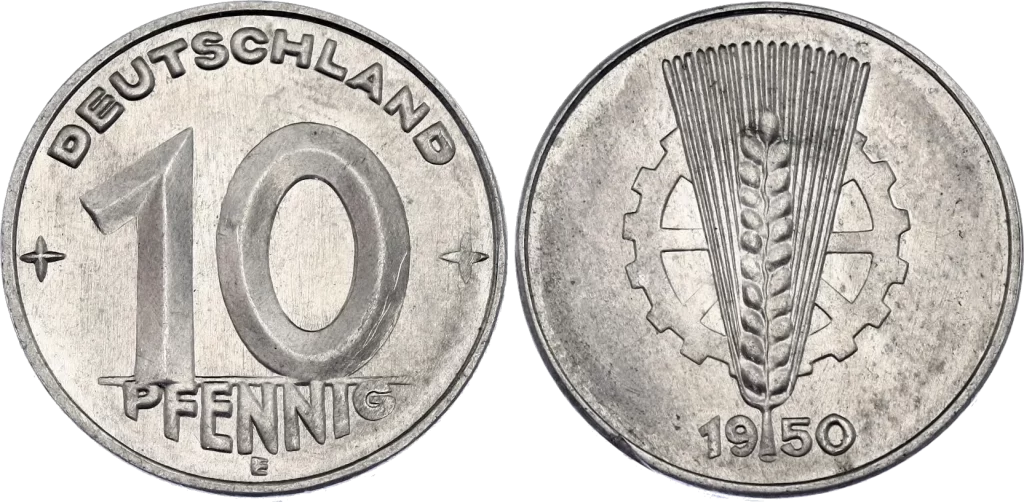
Some mints closed over the years, and their letter was retired, but the system remains to this day. In fact, even with the division of the country into West and East Germany during the Cold War, the letter system was maintained on both sides (Berlin and Muldenhütten on the communist side, the rest on the capitalist side).
10 Pfennig coin from 1950 issued by Communist Germany, with the mint mark “E”, from Muldenhütten, below the denomination (Picture: Katz Auction – Auction 72, Lot 1748).
So now you know, the reason a G appears on the 2024 German commemorative 2 euro coin is because of a law that’s 150 years old.
But be aware, there are two historical exceptions.
The exceptions: Tabora and Vienna
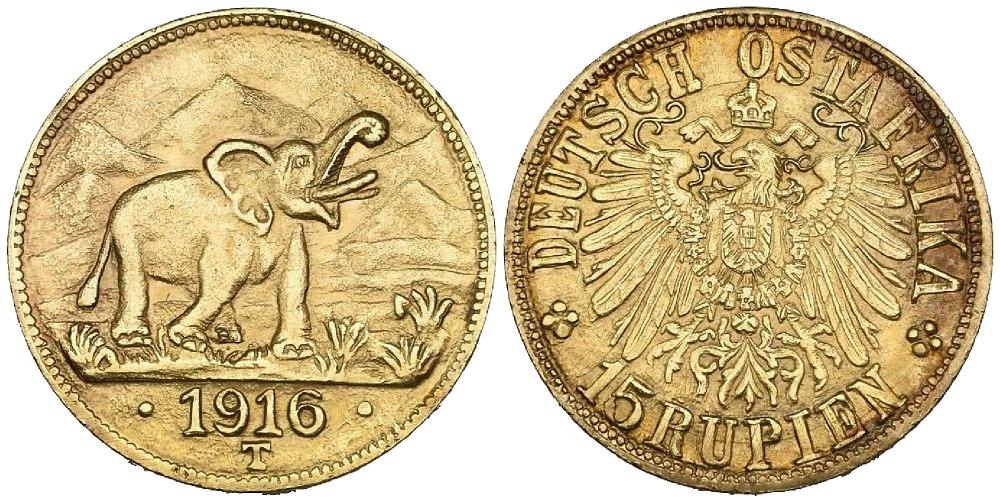
The first exception is the emergency mint in the German African colony of Tabora in 1916 and its really cool rupees. They didn’t have an assigned letter, and given the rudimentary nature of the process and how brief it was, there was no time to assign one. So, they used the “T” for Tabora.
By 1878, the Hannover mint, which used to carry the letter B, had already closed. And when Hitler annexed Austria in 1938, that letter B was assigned to the Vienna mint. When Austria was liberated in 1944, Vienna dropped the B.
Complete list of German mint marks
To finish on a good note, I’ll leave you here a complete list of the letters in the German mint marks, including all periods. It’s an image, so you can save it for your personal use and share it (giving me credit, please!) if you want.
And well, as you can see, although today we know the sequence A, D, F, G, and J by heart, there were indeed mints in Germany with the letters C, E, and even T. It’s a good thing they haven’t survived to our days, because if it’s already difficult to collect coins from five mints, imagine doing it with ten.